Water Tank Waterproofing Services in Pakistan | Roof Power
Roof Power Enterprises (Pvt.) Limited · Registered Private Limited Company · 8+ Years · Lahore · Islamabad · Karachi · Nationwide Call or WhatsApp: 0300-1210012 — Free Water Tank Inspection
Quick Answer
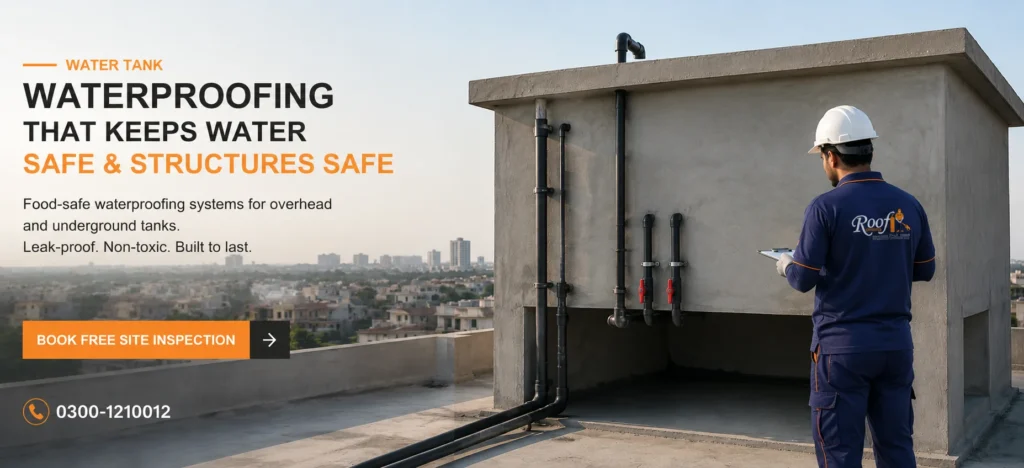
A leaking water tank wastes water, raises your pumping costs, and spreads damp into the structure around it — but the bigger issue is what it’s coated with. A water tank holds drinking water, so the waterproofing material must be non-toxic and safe for potable contact. A generic “chemical” that flakes or leaches into your water is a health risk, not a fix. At Roof Power, we use food-safe cementitious and crystalline systems, treat overhead and underground tanks with the right method for each, and flood-test before the tank goes back into use.
The Question Nobody Asks — but Everybody Should
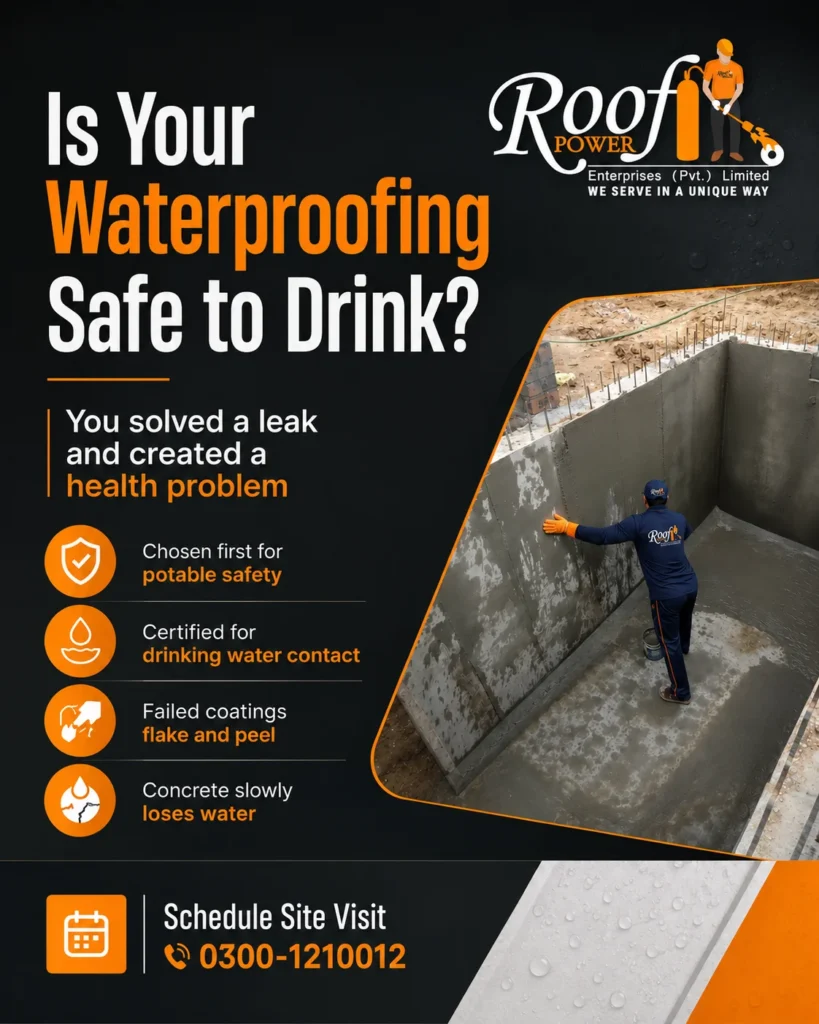
When people call about a water tank, they ask about the leak. Almost nobody asks the question that matters most: is the waterproofing safe to drink from?
It should be the first question. A water tank is the only structure you waterproof that holds water your family drinks. Every other waterproofing job — roof, basement, bathroom — keeps water out of a building. This one keeps water in, and that water goes into your kitchen, your glasses, your children’s bottles.
Yet the most common thing sold for water tanks in Pakistan is simply a “waterproofing chemical,” bought and applied with no thought to whether it’s safe for drinking water. Many general-purpose waterproofing chemicals are not — they can taint the water with taste and smell, and in the worst cases leach substances into it or flake off into the supply. You solved a leak and created a health problem.
Roof Power Enterprises (Pvt.) Limited is a registered Pakistani building protection company. When we waterproof a water tank, the material is chosen first for potable safety — food-grade, non-toxic, certified for drinking-water contact — and then for durability. A tank that holds water but poisons it is not a job well done.
Why Water Tanks Leak
Concrete is porous. An untreated concrete tank slowly loses water through the pores of the concrete itself, even without a visible crack.
Cracks in the walls or floor. Shrinkage, settlement, and thermal cracks open water paths. In a tank, the water is under pressure against every one of them.
Construction joints without water stops. The joints where the tank was cast in stages leak if no water stopper was built in.
Failed previous coating. A generic or badly applied coating flakes, peels, or simply wasn’t potable-safe to begin with — and now it’s failing and contaminating.
External groundwater (underground tanks). An underground tank has a second problem: groundwater pressing inward from outside, especially where the water table is high or during monsoon.
Overhead vs Underground — Two Different Problems
The keyword data splits neatly into overhead and underground tanks, because they genuinely are different jobs.
Overhead tanks (rooftop or elevated) are exposed and structural. The concern is water loss and — critically — seepage into the structure below, because an overhead tank sits on a slab above living space. A leaking overhead tank shows up as damp on the ceiling or wall directly beneath it, much like a leaking bathroom. They’re treated from the inside with a food-safe system, and the structure they sit on is protected too.
Underground tanks face the hardest challenge in waterproofing: they must hold water in and keep groundwater out. Water inside presses outward; groundwater outside presses inward. Under monsoon saturation or a high water table, an underground tank is fighting pressure from both directions. This needs a robust system — often crystalline, which becomes part of the concrete and resists pressure from either side — and, where the external pressure is severe, attention to the surrounding drainage as well.
Treating both types the same way is a common mistake. We diagnose which problem you actually have.
The Right Materials — Food-Safe First
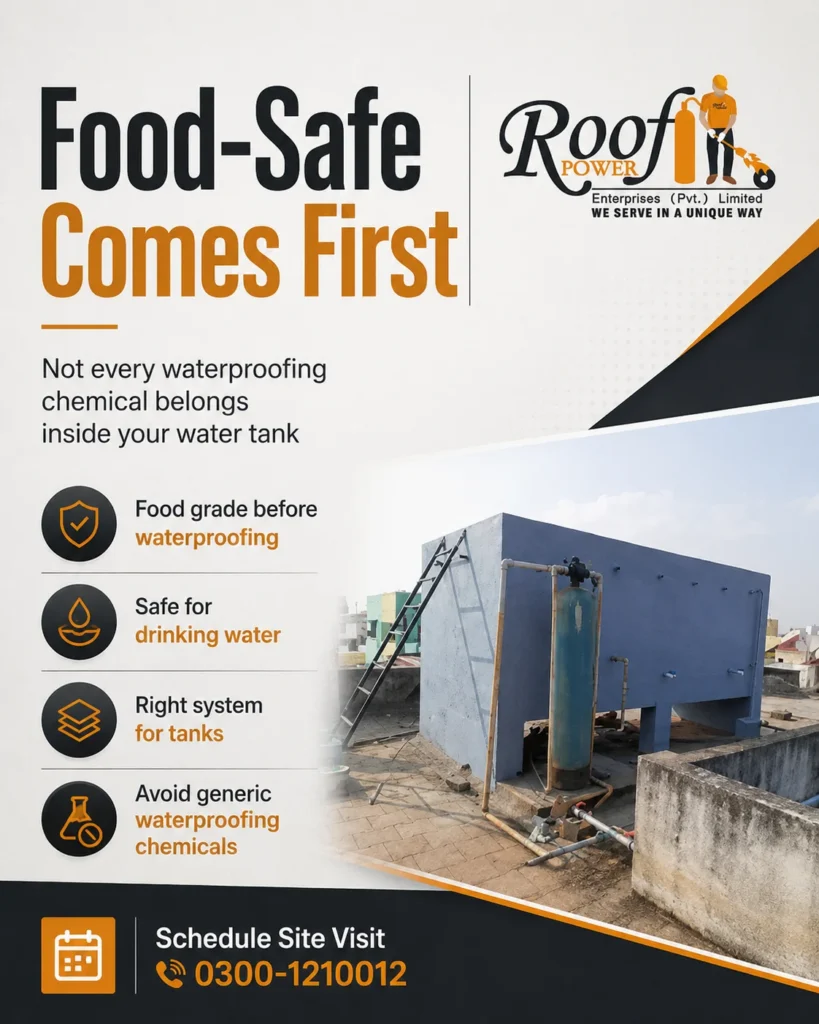
There is no single “best chemical” — there is the right food-safe system for your tank type and condition. The materials we use are chosen to be non-toxic and safe for potable water:
Food-grade cementitious systems. Polymer-modified cementitious coatings certified for potable-water contact bond into the concrete surface, are safe for drinking water, and are well suited to the inside of overhead and underground tanks.
Crystalline waterproofing. Crystalline systems penetrate the concrete and grow crystals within it that block water paths — becoming part of the tank rather than a coating on top. This resists pressure from both sides (ideal for underground tanks), is self-healing over fine cracks, and the appropriate grades are safe for potable water.
Potable-approved coatings and joint treatments. Where a coating or a water stopper at a joint is needed, we use materials suitable for drinking-water contact.
What we don’t do is brush a generic, unverified “waterproofing chemical” into a tank your family drinks from. That’s the shortcut this whole page exists to warn against.
Signs Your Water Tank Needs Waterproofing
- The tank level drops faster than your usage explains (it’s losing water)
- Rising pumping/electricity cost as the tank leaks and refills
- Damp patches on the ceiling or wall below an overhead tank
- Damp or seepage around an underground tank, or in an adjacent basement/wall
- Discoloured, smelly, or bad-tasting water (a coating or contamination issue)
- Visible algae or slime inside the tank
- Cracks visible in the tank walls or floor
- Efflorescence (white salt) on the outside of the tank structure
Who Needs Water Tank Waterproofing
Homeowners — with overhead or underground tanks that are leaking, damaging the structure, or raising contamination concerns.
Plaza and apartment owners — large shared tanks where a leak affects the whole building and pumping costs.
Factories and industrial users — process and storage tanks.
Hospitals, schools, and institutions — where water safety is a compliance and welfare issue.
Builders and developers — waterproofing tanks correctly at construction, with joints and water stops done right.
Water-supply and commercial projects — larger reservoirs and water-retaining structures.
Our Inspection
Step 1 — Identify the tank type and problem. Overhead or underground? Losing water, seeping into the structure, or a contamination concern — or all three?
Step 2 — Diagnose the source. Porous concrete, cracks, joints, or (underground) external groundwater pressure.
Step 3 — Structural check. Are cracks stable or a sign the tank structure is failing? A structurally compromised tank needs repair before waterproofing.
Step 4 — Assess the existing coating. Is a previous coating failing or unsafe, and does it need full removal?
Step 5 — Confirm the safe method and material for that tank and its use.
Step 6 — Written recommendation. Method, food-safe material, downtime, cost, and exclusions — in writing.
Our Process
A water tank can’t be waterproofed while it’s full and in use. The process is:
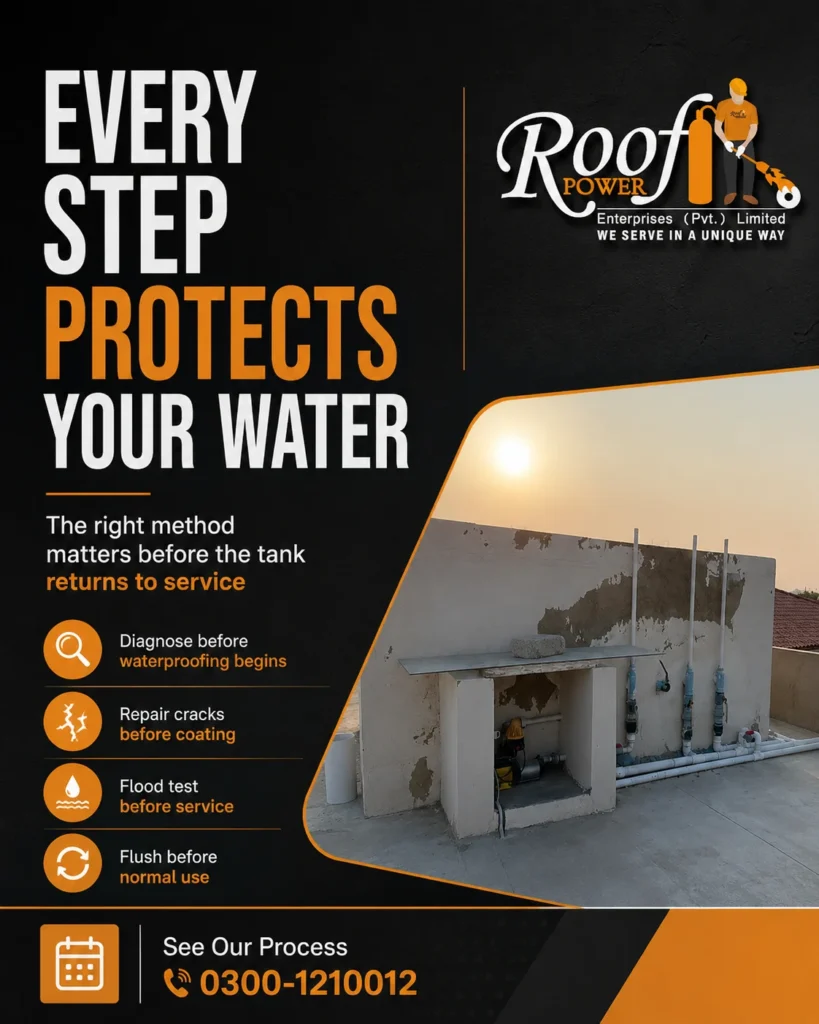
- Drain and clean the tank completely.
- Remove any failed or unsafe existing coating back to sound concrete.
- Prepare the surface — clean, sound substrate is essential for bonding.
- Repair cracks and treat joints — with food-safe repair materials and water stoppers where needed.
- Apply the food-safe waterproofing system — cementitious and/or crystalline, at the correct coats/thickness, to walls and floor.
- Cure the system properly — potable coatings need adequate curing before water contact.
- Flood test — refill and hold for 48–72 hours to confirm no leakage before the tank returns to service.
- Flush and clean before normal use, and hand over with maintenance guidance.
The tank is out of use during this — we plan it around your water supply, and for buildings that can’t lose supply entirely, we phase or advise on temporary arrangements.
Applications
Overhead / rooftop tanks — homes, villas, plazas: stop water loss and protect the slab below. Underground tanks — homes, plazas, factories: hold water in and resist groundwater. Commercial and institutional tanks — hospitals, schools, hotels, factories. Large reservoirs and water-retaining structures — for developers and water projects. New construction — tanks waterproofed correctly with joints and water stops at build stage.
Practical Project Examples
Representative examples of the situations we handle. Real Roof Power project case studies with photographs are being added to this page.
Overhead tank — Rooftop, Lahore. Problem: Damp spreading across the ceiling of the top-floor room directly below the rooftop water tank; the tank was also losing water. Findings: Porous concrete and a cracked floor slab in the tank; a previous coating had partly flaked (into the water). Approach: Drain and clean, remove the failed coating, repair cracks, apply a food-safe cementitious/crystalline system, cure, and flood-test. Point of the story: The old coating was both failing and contaminating — the new system had to be safe as well as sound.
Underground tank — Karachi. Problem: An underground tank losing water and showing seepage; a high local water table. Findings: Water escaping from inside and groundwater entering from outside — pressure from both directions. Approach: Crystalline waterproofing that becomes part of the concrete and resists two-sided pressure, joint water stops, and attention to surrounding drainage. Point of the story: An underground tank is a two-sided problem, and crystalline is built for exactly that.
Commercial — Plaza tank, Islamabad. Problem: A large shared underground tank leaking, raising pumping costs and damaging an adjacent basement wall. Approach: Crystalline treatment, joint sealing, and coordination with the basement waterproofing next to it, flood-tested before return to service. Point of the story: On a shared tank, one leak is everyone’s cost — fixed once, safely.
What Affects the Cost
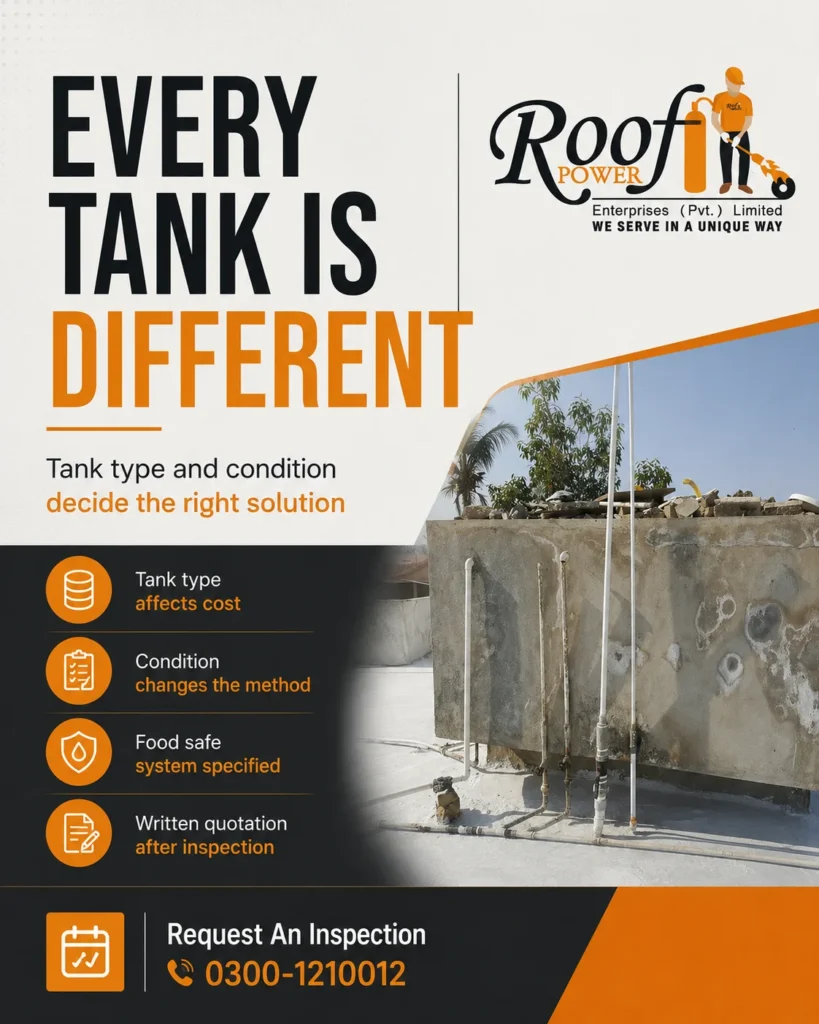
- Tank type — overhead vs underground (underground’s two-sided pressure is more involved).
- Tank size and surface area.
- Condition — porous concrete vs cracked/structurally damaged.
- Existing coating removal — stripping a failed/unsafe coating.
- Material — the food-safe system specified.
- Access — how easily the tank can be reached and worked in.
- Downtime constraints — phasing where supply can’t be interrupted.
Pricing disclaimer: cost is provided in a written quotation after inspection.
Project Timeline
| Stage | Typical duration |
| Inspection & recommendation | Same day–1 day |
| Drain, clean, prepare | 1–2 days |
| Repair & apply system | 1–3 days |
| Curing | System-dependent (potable coatings need proper cure) |
| Flood test | 48–72 hours |
| Flush & handover | 1 day |
The tank is out of use through the works, curing, and flood test — we plan it around your supply.
Common Mistakes
Using a generic chemical on a drinking-water tank. The single most important mistake — it can taint or contaminate the water. Food-safe material is non-negotiable.
Treating overhead and underground tanks the same. Underground tanks fight two-sided pressure and need a system built for it.
Not draining or preparing properly. Waterproofing bonds to a clean, sound, dry substrate — not to slime, algae, or a failing old coat.
Skipping the flood test. Without refilling and holding, you don’t actually know it’s sealed.
Not curing before use. Potable coatings need to cure before water contact; rushing it undermines both safety and durability.
Ignoring joints. Construction joints without water stops leak.
Risks of Ignoring a Leaking Tank
- Ongoing water loss and higher pumping/electricity costs
- Contaminated drinking water — a genuine health hazard
- Damp and structural damage to the slab or walls around the tank
- Corrosion of reinforcement in the tank structure
- Algae and bacterial growth in a compromised tank
- Damage to adjacent rooms (below an overhead tank) or basements (beside an underground tank)
Honest Limitations
Structurally failing tanks need repair first. If the tank is structurally cracked or the concrete is failing, that’s an engineering repair before waterproofing — a coating won’t hold a structure together.
The tank must be out of use during works. There’s no way to waterproof a tank in service. We plan around your supply, but downtime is unavoidable.
Underground external pressure may need drainage too. Where groundwater pressure is severe, waterproofing the tank may need to be paired with drainage around it — the same principle as basement waterproofing.
Maintenance and periodic cleaning matter. A tank should be cleaned periodically; the waterproofing lasts longer in a maintained tank.
Nothing is permanent. Service life depends on the system, application, use, and maintenance. There’s no lifetime guarantee on a water-retaining structure in daily use.
Why Choose Roof Power Enterprises (Pvt.) Limited
- A registered private limited company — traceable and accountable.
- 8+ years across overhead and underground tank waterproofing.
- We put potable safety first — food-safe, non-toxic materials for a tank you drink from.
- We treat overhead and underground tanks correctly — different problems, different methods.
- We drain, prepare, cure, and flood-test — the full process, not a chemical brushed into a full tank.
- We rule out structural problems and tell you honestly if a tank needs repair first.
- Full water-retaining expertise — tanks, pools, and wet areas.
- Three offices — Lahore, Islamabad, Karachi — with nationwide coverage.
- Named leadership — CEO & Founder Muhammad Haseeb Hassan reviews technical recommendations.
Frequently Asked Questions
Are Water Tank Waterproofing Services in Pakistan Safe for Drinking Water?
It must be — and that’s the most important thing to check. A water tank holds drinking water, so the waterproofing material has to be non-toxic and certified safe for potable-water contact. Roof Power uses food-grade cementitious and crystalline systems chosen for exactly this. A generic waterproofing chemical that isn’t potable-safe can taint or contaminate your water, which is why we lead with material safety, not just leak-stopping.
What is the best waterproofing chemical for a water tank?
There’s no single “best chemical” — there’s the right food-safe system for your tank type and condition. Food-grade cementitious coatings and crystalline systems are the appropriate choices because they’re durable, bond into the concrete, and are safe for drinking water. The right one depends on whether the tank is overhead or underground and its condition, which is why we inspect first.
How is an overhead water tank waterproofed?
An overhead tank is drained and cleaned, any failed coating is removed, cracks and joints are repaired, and a food-safe cementitious or crystalline system is applied to the inside walls and floor, cured, and flood-tested. Because an overhead tank sits above living space, protecting the slab it stands on from seepage is part of the job.
How is an underground water tank waterproofed?
An underground tank has to resist water from inside and groundwater from outside, so it needs a system built for two-sided pressure — usually crystalline waterproofing, which becomes part of the concrete. The tank is drained, prepared, treated at cracks and joints, cured, and flood-tested; where external groundwater pressure is severe, surrounding drainage may be addressed too.
Why is my water tank losing water?
Concrete is porous and loses water slowly even without a visible crack; cracks and un-sealed construction joints accelerate it under the water’s pressure. A failed previous coating is another common cause. An inspection identifies which, so the right system is applied.
Do you have to empty the tank to waterproof it?
Yes. A tank can’t be waterproofed while full and in use — it must be drained, cleaned, and prepared for the material to bond, then cured and flood-tested before returning to service. We plan the work around your water supply.
How much does water tank waterproofing cost in Pakistan?
It depends on the tank type (underground is more involved than overhead), size, condition, whether an old coating must be removed, the food-safe material specified, and access. We provide a written quotation after inspection.
Can a leaking concrete water tank be repaired without rebuilding?
Usually yes. If the tank is structurally sound, draining it, repairing the cracks and joints, and applying a food-safe waterproofing system resolves the leak without rebuilding. Only a structurally failing tank needs reconstruction — and we’ll tell you honestly if that’s the case.
Will the water taste or smell different after waterproofing?
Not with a proper food-safe system, once cured and flushed. Taste and smell problems come from using non-potable-safe chemicals — which is exactly what we avoid. We recommend cleaning and flushing the tank before normal use after any work.
Which cities do you serve?
Our offices are in Lahore, Islamabad, and Karachi, and we deliver water tank waterproofing across Pakistan.
A Note from the Founder

Of all the waterproofing we do, the water tank is the one I care about most getting right — because it’s the only one where the water we’re dealing with goes into people’s bodies.
It troubles me how casually water tanks are treated in Pakistan. Someone buys a “waterproofing chemical,” brushes it into the tank, and never once asks whether it’s safe to drink from. Many of those chemicals aren’t. They taint the water, and some flake straight back into it. You fixed a leak and gave your family a health problem.
So when my team waterproofs a tank, the material is chosen for potable safety first, durability second — food-grade, non-toxic, made for drinking-water contact. We drain the tank, prepare it properly, treat it, cure it, and flood-test it before a drop goes back in. And if a tank is overhead, we treat it differently from an underground one, because they’re genuinely different problems.
If your tank is leaking, or you’re not sure the water in it is safe, let us look at it properly.
Muhammad Haseeb Hassan CEO & Founder, Roof Power Enterprises (Pvt.) Limited
Book Your Free Water Tank Inspection
If your tank is losing water, spreading damp, or you’re worried about what’s in your water — let us inspect it and recommend a safe, lasting solution.
Call or WhatsApp: 0300-1210012 Email: roofpowers@gmail.com
Our offices: Lahore — Office No.1, Millat Tractor Cooperative Housing Society, New Defence Road Islamabad — Office No.3, Roshan Plaza, Sector H-13 Karachi — 2nd Floor, Hassan Square, Gulshan-e-Iqbal
Overhead or underground, home or commercial — we waterproof it with food-safe materials, the right method, and a flood test. Builder or developer? We waterproof tanks to specification at construction, with joints and water stops done right.
Roof Power Enterprises (Pvt.) Limited — Registered Private Limited Company · 8+ Years · Waterproofing & Building Protection Across Pakistan.
Disclaimers. Materials are selected for potable-water contact; tanks should be cleaned and flushed before returning to use. Recommendations are subject to physical inspection. Method depends on tank type, condition, and whether structural cracks are present; structurally failing tanks may require engineering repair before waterproofing. The tank must be drained and out of use during works and curing. Pricing is provided in a written quotation after inspection. Warranty terms depend on method and scope and are stated in the quotation.