Roof Waterproofing Services in Pakistan | Free Inspection
Roof Power Enterprises (Pvt.) Limited · Registered Private Limited Company · 8+ Years · Lahore · Islamabad · Karachi · Nationwide Call or WhatsApp: 0300-1210012 — Free Roof Inspection
Quick Answer
If your ceiling shows damp patches, blistering paint, or water marks after rain, your roof slab is already absorbing water. A professional roof waterproofing service diagnoses the entry point, repairs cracks and joints, corrects slope and drainage so water cannot pond, and then applies a waterproofing system suited to that specific roof. At Roof Power Enterprises, we inspect the roof first, explain what failed and why, and only then recommend a system. Free inspections are available across Pakistan.
Your Roof Is Not Leaking Because of Rain. It Is Leaking Because Something Failed.

Every monsoon, our team receives the same call: “We did waterproofing two years ago and it is leaking again.”
In our experience, that second failure is almost never caused by bad rain. It is caused by a treatment that was applied without a diagnosis — a chemical coat brushed over a roof that actually needed crack repair, slope correction, or a proper membrane. The material was not necessarily wrong. It was simply never the right answer to the question, because nobody asked the question.
Roof Power Enterprises (Pvt.) Limited is a registered Pakistani building protection company. We provide engineered roof waterproofing for houses, plazas, factories, schools, hospitals, and commercial buildings across Pakistan, with offices in Lahore, Islamabad, and Karachi. Before we begin any waterproofing project, our inspection team physically evaluates the roof and issues a written diagnosis. We would rather lose a job than sell a system a roof does not need.
This page explains how roof waterproofing actually works, how we diagnose it, what each system can and cannot do, what genuinely affects the cost, and how to judge any waterproofing company — including ours.
Why Roof Waterproofing Matters More in Pakistan Than Most Buyers Realise
A Pakistani roof endures a punishing annual cycle. Summer surface temperatures on an exposed RCC slab can climb far above ambient air temperature, expanding the concrete. At night it contracts. This daily thermal cycling opens hairline cracks. Then the monsoon arrives and drives water into those cracks under pressure.
Once water is inside the slab, four things follow:
Structural risk. Water reaching the steel reinforcement inside RCC causes corrosion. Corroding steel expands, which spalls the concrete from the inside. This is slow, invisible, and expensive.
Escalating repair cost. Sealing a live crack early is a modest job. Rebuilding a spalled slab section, re-plastering ceilings, and repainting three rooms is not.
Health and habitability. Persistent damp produces mould and fungal growth on ceilings and internal walls — a genuine concern in bedrooms and in schools, hospitals, and food-related facilities.
Property value and business disruption. A stained ceiling devalues a home. A leaking factory roof stops production and can destroy stored inventory.
Waterproofing is not a cosmetic upgrade. It is the maintenance of the building envelope — the single layer standing between your structure and the weather.
Understanding the Problem: Why Roofs Actually Leak
Our engineers carefully inspect for six root causes. In the great majority of the roofs we assess, the leak traces back to one or more of these — not to “old concrete” in general.
1. Thermal cracking of the slab. Expansion and contraction opens hairline cracks that widen over years. These are the classic monsoon-only leaks: dry for ten months, wet for two.
2. Ponding water from incorrect slope. A flat roof is never meant to be truly flat. It requires a fall toward the rainwater outlets. Where the slope is wrong or the screed has settled, water stands for days. Standing water finds any weakness, and it degrades most coatings faster than moving water ever will.
3. Blocked or badly detailed drainage. A choked rainwater outlet turns the entire roof into a shallow tank. We frequently find outlets sitting above the surrounding roof level — meaning water can never fully drain by design.
4. Failure at the parapet junction. The joint where the horizontal roof meets the vertical parapet wall is the most common leak point on any Pakistani roof, and the one most often skipped. Waterproofing must turn up the parapet and terminate properly. A coating that stops at the corner will fail at the corner.
5. Penetrations. Water tank bases, pipe outlets, TV mounts, solar panel anchors, and staircase blocks all pierce the waterproofing layer. Every penetration needs its own detailing.
6. Previous treatment failure. Wrong material for the exposure, application over a damp or dusty substrate, no primer, overlaps not sealed, or work rushed before rain. Adhesion failure is a workmanship failure, not a material failure.
Signs Your Roof Needs Waterproofing
- Damp patches or water stains on the ceiling, especially in corners
- Paint bubbling, blistering, or flaking from the ceiling or upper walls
- A musty smell in upper rooms after rain
- Visible hairline or map-pattern cracks on the roof surface
- Water standing on the roof more than 24–48 hours after rain
- White salt deposits (efflorescence) on ceilings or the roof surface
- Previous waterproofing that is peeling, cracking, or lifting at the edges
- Rising electricity bills alongside an unusually hot top floor — a wet slab conducts heat
If you can see two or more of these, water is already inside the slab. Waiting until it drips is waiting too long.
Who Needs Roof Waterproofing Services
Homeowners, villa and farmhouse owners. Houses with RCC slabs, terraces, and rooftop water tanks — particularly properties over ten years old or with any previous failed treatment.
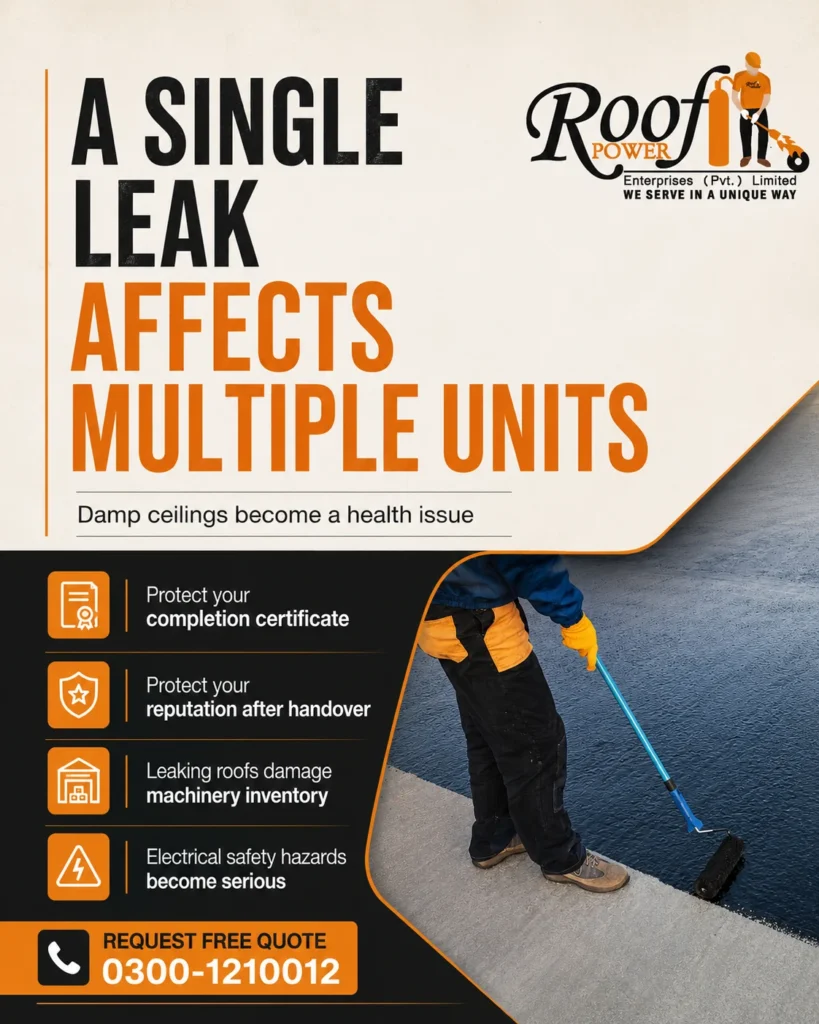
Apartment and plaza owners. Shared roofs where a single leak affects multiple units and generates tenant disputes.
Builders and developers. Waterproofing applied correctly at construction stage, with membranes properly lapped and detailed before finishes go on, is dramatically cheaper than remedial work after handover — and it protects your completion certificate and your reputation.
Architects and consulting engineers. We work to specification and provide material data sheets and application records for project documentation.
Contractors. We take on waterproofing as a specialist sub-package on larger builds.
Factory and warehouse owners. Leaking industrial roofs damage machinery and inventory, and create serious electrical safety hazards.
Institutions — schools, universities, hospitals, government buildings. Where damp ceilings become a health and compliance issue, not just a maintenance one.
Our Inspection Process
We do not quote roof waterproofing over the phone. A price given without an inspection is a guess, and guesses are how buildings get the wrong system.
Step 1 — Site inspection. Our team visits and walks the entire roof surface, parapets, drains, and the ceilings below.
Step 2 — Problem diagnosis. We locate the actual entry points. Water travels along the slab before it appears below, so the wet ceiling patch is rarely directly beneath the crack that caused it.
Step 3 — Moisture assessment. We assess how saturated the slab is. Applying a sealed membrane over a saturated slab traps moisture, which can cause the new layer to blister and lift.
Step 4 — Structural evaluation. We check crack width and pattern. A hairline shrinkage crack is a waterproofing matter. A wide, active structural crack is not — that requires a structural engineer first, and we will tell you so.
Step 5 — Slope and drainage evaluation. We check the fall toward outlets and identify ponding zones. If the slope is wrong, no coating on earth will save that roof for long.
Step 6 — Material and exposure assessment. Roof usage matters. A roof with regular foot traffic, a rooftop garden, or heavy equipment needs a different system from an unused terrace.
Step 7 — Written recommendation. You receive a clear scope: what is wrong, what we recommend, what material, what preparation, what it costs, and — just as importantly — what is not included.
Our Roof Waterproofing Process
1. Surface preparation. The stage most often skipped, and the stage that decides the outcome. We remove all loose material, previous failed coatings, dust, oil, and algae. Waterproofing bonds to sound substrate, not to debris. If the surface is not right, nothing above it will hold.
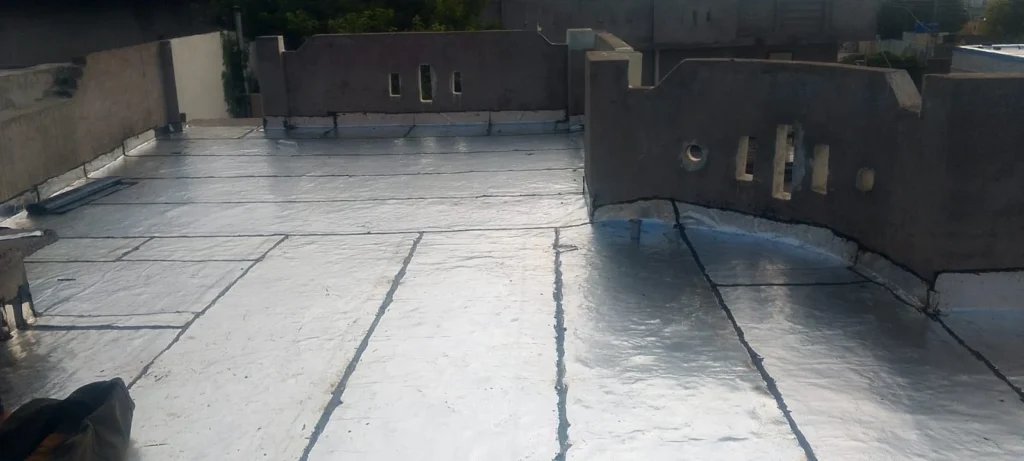
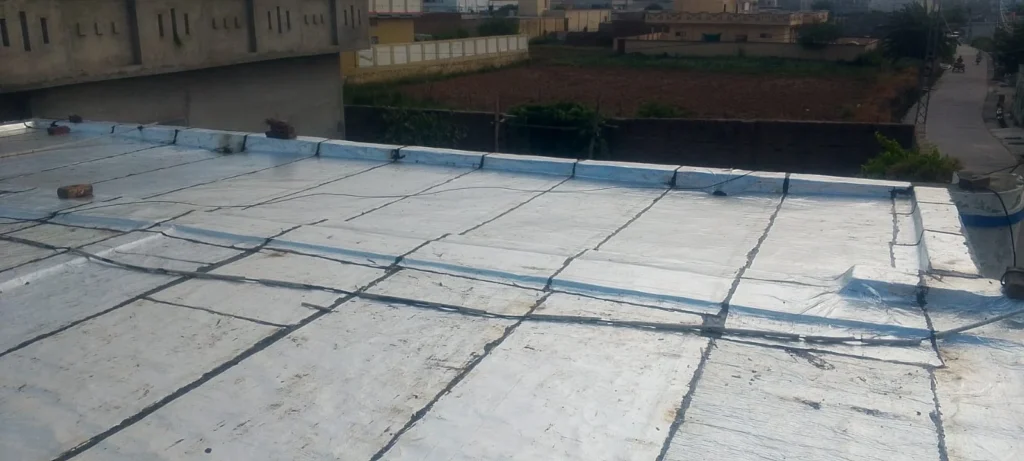
2. Crack and joint repair. Cracks are opened out, cleaned, and filled with an appropriate repair mortar or sealant. Parapet junctions receive a fillet so the membrane can turn up the wall without a sharp 90° angle, which is where membranes tear.
3. Slope and drainage correction. Where needed, we lay a screed to establish a proper fall toward the outlets and reset the drains to the correct level.
4. Priming. The primer creates the bond between the substrate and the waterproofing layer. Skipping primer to save cost is the single most common cause of peeling waterproofing we see on Pakistani roofs.
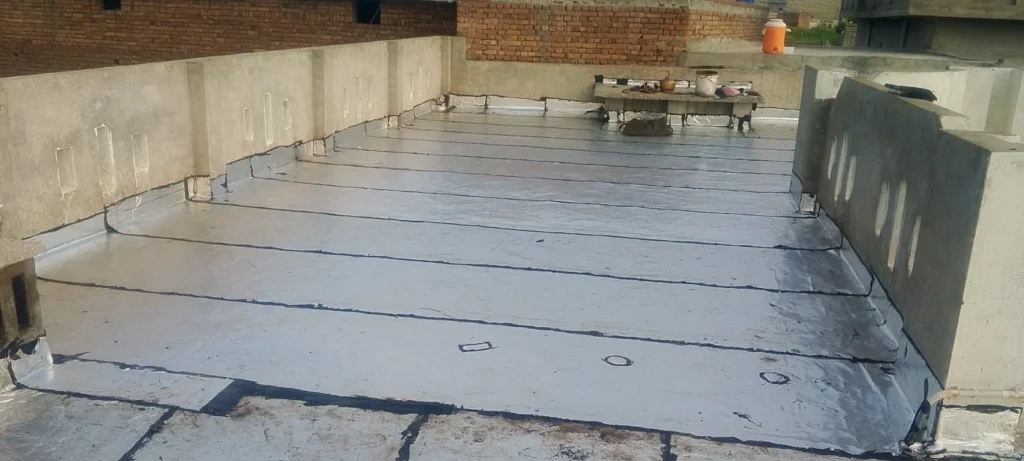
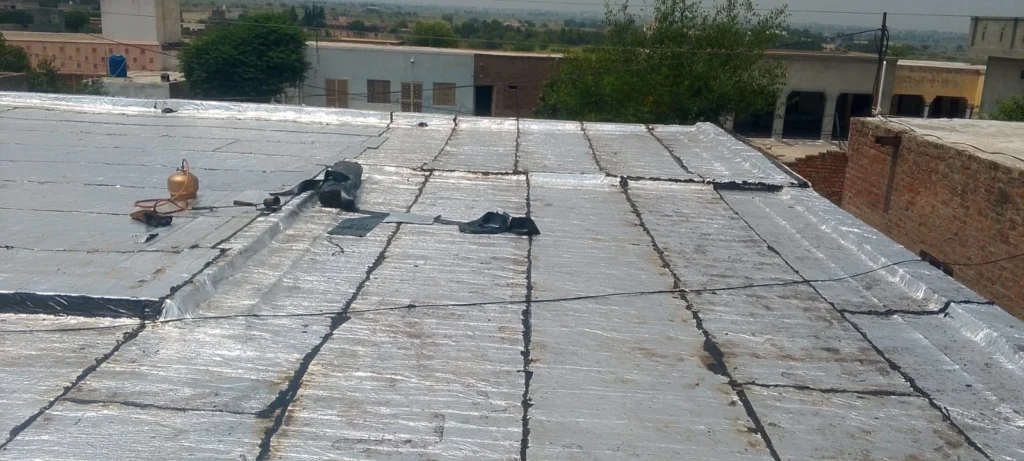
5. System application. Membrane is torch-applied or self-adhered with correctly sealed overlaps and upstands at every parapet and penetration. Liquid systems are applied in the specified number of coats at the specified thickness — not “until the drum runs out.”
6. Quality control. Our supervisor checks overlap sealing, upstand height, coating thickness, and detailing at every penetration during application, not after.
7. Water / flood testing. Where the roof design permits, we pond the roof and hold water to confirm there is no penetration before we call the job complete.
8. Handover and customer guidance. We explain what was done, what maintenance the system needs, and what will void its performance.
Materials & Technology: What We Use and What It Can Actually Do
There is no single “best” waterproofing material. There is only the right material for a specific roof, exposure, and budget. Any company that recommends the same product for every roof is selling stock, not solutions.
| System | Best suited for | Key advantages | Honest limitations |
| SBS / APP Bitumen Membrane (torch-applied) | Large roofs, plazas, factories, terraces, roofs with ponding risk | Thick, robust, proven; excellent for standing water; long service life; strong at joints and upstands | Requires skilled torch application; needs a protective screed or reflective topcoat under sun; seams must be laid correctly |
| Liquid Elastomeric / Polyurethane Coating | Roofs with complex shapes, many penetrations, foot traffic | Seamless — no joints to fail; bridges hairline cracks; excellent around obstacles | Thickness depends entirely on workmanship; needs full recoat cycles; unsuitable for permanent ponding |
| Acrylic Waterproof Coating | Sound roofs, preventive protection, budget projects | Cost-effective; reflective (reduces heat); easy to reapply | Thinner film; shorter cycle; not for standing water or active leaks |
| Cementitious Slurry / Crystalline | Water tanks, sunken slabs, screed layers, negative-side applications | Bonds into concrete; safe for potable water tanks; works under finishes | Rigid — does not bridge moving cracks; must be paired with a flexible layer on exposed roofs |
| Bitumen Membrane + Reflective Topcoat | Pakistani exposed roofs with both heat and leakage problems | Waterproofing plus heat reduction in one specification | Higher initial cost; the reflective coat needs periodic renewal |
On heat. Roof waterproofing and roof heatproofing are related but not identical. Waterproofing stops water. Heatproofing reduces the heat transferred into the building below. Some systems do both, and on a Pakistani roof we usually recommend specifying for both together — it is far cheaper to do them in one operation than to re-do the roof twice.
Applications
Residential
Houses, villas, farmhouses, apartments. Typical issues: monsoon ceiling seepage, terrace cracking, leakage from the water tank base, damp at parapet corners, and previous coatings that peeled within one or two seasons. The usual solution is thorough preparation, crack and junction repair, and a membrane or elastomeric system with an appropriate topcoat.
Commercial
Plazas, offices, hotels, shopping malls, schools, universities, hospitals, showrooms. Larger roof areas, more penetrations, HVAC equipment, and greater consequences — a leak in a mall or hospital ceiling is a liability event, not an inconvenience. These projects require a phased plan so the building can remain operational, and full documentation for the facilities team.
Industrial
Factory sheds, warehouses, manufacturing plants, godowns, cold storage. Priorities shift: protecting machinery and inventory, maintaining electrical safety, and minimising production downtime. Work is often scheduled around shutdown windows. Roof Power handles industrial waterproofing with site supervision, safety protocols, and a written project schedule.
Practical Project Examples
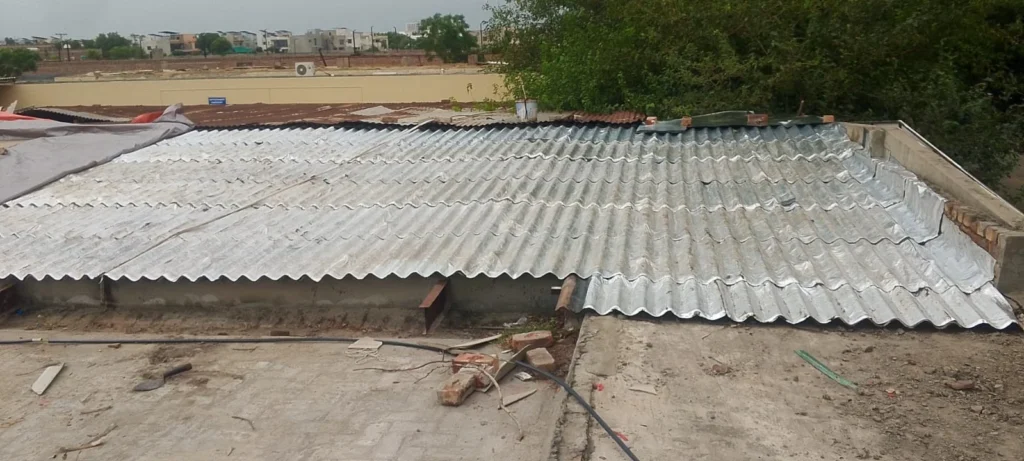
Representative examples of the situations we handle. Real Roof Power project case studies with photographs are being added to this page.
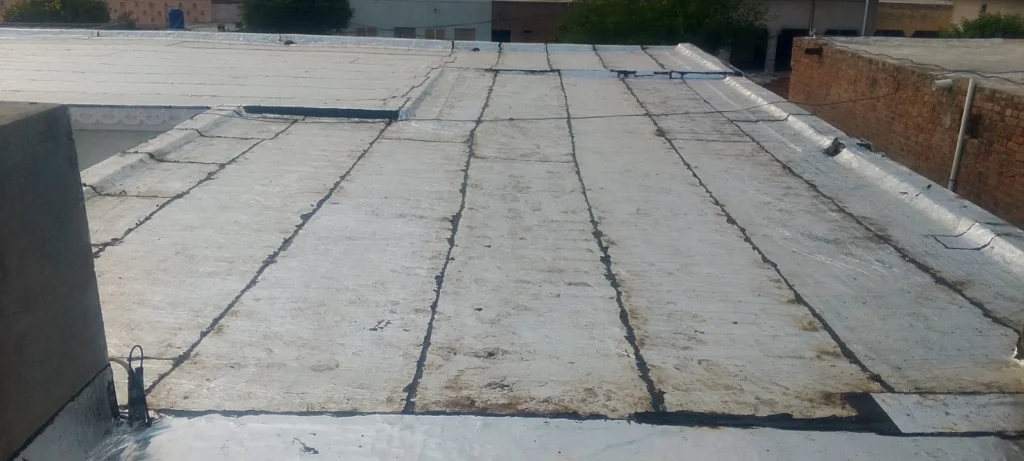
Residential — Lahore, 8-year-old house. Problem: Ceiling damp in two bedrooms every monsoon; the owner had applied a chemical coating two years earlier. Inspection findings: The coating was intact across the field of the roof but had never been turned up the parapet. Water was entering at the roof-to-parapet junction and travelling under the coating. The rainwater outlet was also 25 mm above the roof surface, so water never fully drained. Recommendation: Remove the coating, cut and reset the drain, form fillets at all parapet junctions, apply SBS bitumen membrane with 150 mm upstands, finish with a reflective topcoat. Outcome: Sealed junctions and a functioning drain — the two things the original treatment never addressed.
Commercial — Plaza roof, Islamabad. Problem: Water entering top-floor office ceilings; tenants threatening to vacate. Inspection findings: Ponding across roughly a third of the roof due to a settled screed; multiple untreated pipe penetrations. Recommendation: Slope-correcting screed, individual detailing at every penetration, torch-applied membrane, flood test before handover, work phased over weekends to keep offices open. Outcome: Drainage corrected first; waterproofing applied to a roof that could actually shed water.
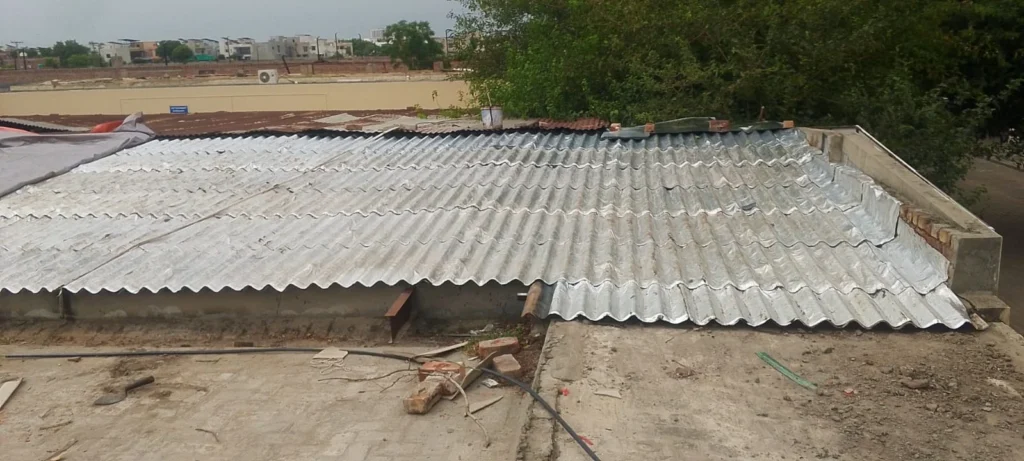
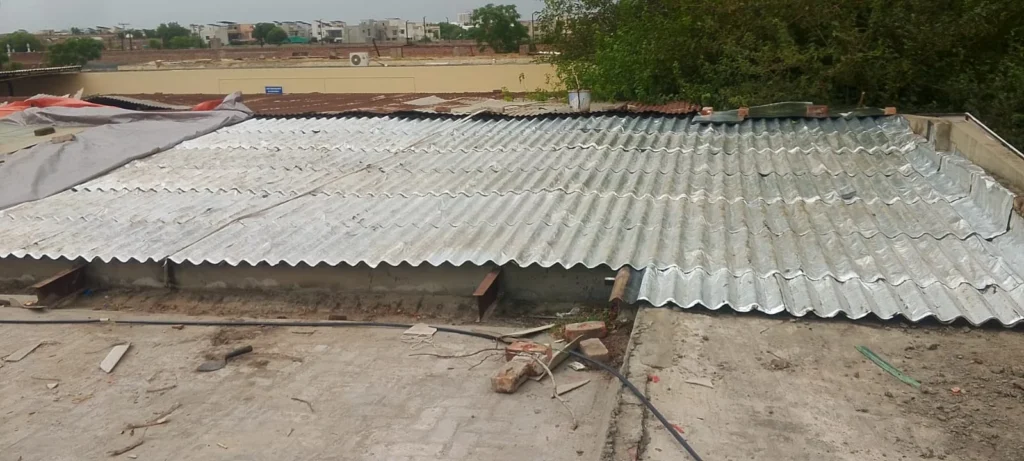
Industrial — Factory roof, Karachi. Problem: Rainwater dripping onto production machinery; electrical safety hazard. Inspection findings: Failed joints and corroded fixings on the shed roof; standing water on the adjoining RCC portion. Recommendation: Joint and fixing treatment on the shed section, membrane system with protective layer on the RCC section, work scheduled around the plant’s shutdown window. Outcome: Machinery protected without an unplanned production stoppage.
What Actually Affects the Cost

We do not publish fixed per-square-foot rates, and we would gently suggest you distrust any company that does before seeing your roof. A number quoted without an inspection is a number that will change once work begins.
Genuine cost drivers:
- Roof area and geometry. Larger areas cost less per unit; complex, cut-up roofs with many corners cost more.
- Existing condition. A sound roof needing preventive protection is a different job from a saturated slab with structural cracks.
- Preparation and removal. Stripping a failed previous coating is real labour and real cost.
- Slope and drainage correction. If a screed is required, this can be a significant line item — and it is not optional if water is ponding.
- System specified. Membrane, elastomeric, acrylic, and cementitious systems sit at different price points.
- Number of penetrations. Each pipe, tank base, and anchor needs individual detailing.
- Access. Whether material can be lifted easily to the roof, and whether scaffolding is needed.
- Site constraints. Occupied buildings, night work, phased handovers, and industrial shutdown windows all affect cost.
- Protective finishes. Screed, tiles, or reflective coatings over the membrane.
What we will commit to: after inspection, you receive a written scope with the system named, the preparation described, and the exclusions stated. No surprises mid-project.
Project Timeline
| Stage | Typical duration |
| Inspection & written recommendation | 1–2 days |
| Surface preparation & crack repair | 1–3 days |
| Slope / screed correction (if required) | 2–4 days + curing |
| System application | 1–4 days depending on area |
| Curing | System-dependent |
| Water / flood test | 24–48 hours |
| Final inspection & handover | 1 day |
Timelines vary with roof size, weather, and the extent of repair required. We do not apply waterproofing to a wet substrate or immediately before forecast rain, because it will not bond — and we will reschedule rather than compromise the work.
Common Mistakes We See on Pakistani Roofs
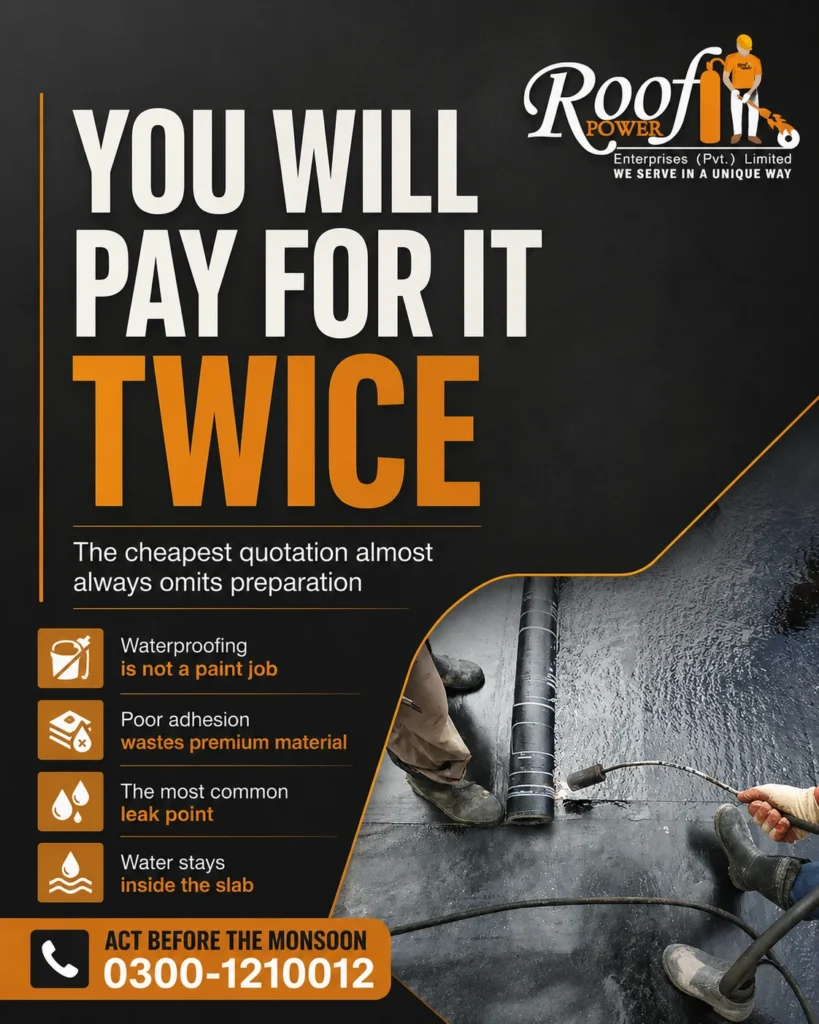
Treating waterproofing as a paint job. A brush-applied chemical over a dirty, cracked, ponding roof is money spent on delay, not on a solution.
Skipping surface preparation. No amount of premium material compensates for poor adhesion.
Ignoring the parapet junction. The most common leak point and the most commonly skipped detail.
Waiting for the monsoon to prove there is a problem. By the time water drips through the ceiling, it has been inside the slab for a long time. Pre-monsoon is the right time to act — and it is also when good contractors are already booked.
Choosing on price alone. We understand the temptation. But the cheapest quotation almost always omits preparation, primer, or upstands — and you will pay for it twice.
No maintenance. Drains block. Rooftop foot traffic damages coatings. A roof inspected once a year lasts significantly longer than one that is never looked at again.
Risks of Ignoring Roof Seepage
- Corrosion of reinforcement steel and eventual concrete spalling
- Damage to ceilings, plaster, paint, and electrical fittings
- Mould and fungal growth affecting indoor air quality
- Reduced insulation performance and higher cooling costs
- Damage to stock, machinery, and equipment in commercial and industrial buildings
- Business disruption and tenant loss
- Sharply higher remedial costs the longer it is left
- Reduced building lifespan and resale value
Honest Limitations — What Roof Waterproofing Cannot Do
We would rather tell you this now than after we have taken your money.
Waterproofing does not fix structural problems. If your slab has wide, active, moving cracks, or visible deflection, a waterproofing layer will simply crack along with it. That roof needs a structural engineer’s assessment first. We will say so, and we will not take the job on false pretences.
Waterproofing is not permanent. No system lasts forever. Service life depends on the system specified, the quality of the application, exposure, foot traffic, and maintenance. Any company promising a lifetime guarantee is describing a marketing position, not an engineering one.
A wet slab must dry first. Sealing a fully saturated slab can trap moisture beneath the membrane and cause blistering. Sometimes the correct professional advice is to wait.
Some leaks are not roof leaks. Water travels. We have traced “roof leaks” to a cracked water tank, an internal plumbing line, and a neighbour’s parapet. This is precisely why we inspect before we quote.
Maintenance is your part of the contract. Blocked drains, damage from foot traffic, or new penetrations drilled through the membrane will shorten the life of any system, however well it was applied.
Why Choose Roof Power Enterprises (Pvt.) Limited
- A registered private limited company — not an informal team you cannot trace after the job.
- 8+ years of field experience across residential, commercial, and industrial roofs.
- Diagnosis before quotation — always. A physical inspection and a written recommendation.
- Three offices — Lahore, Islamabad, Karachi — with nationwide project coverage.
- Named, accountable leadership — CEO & Founder Muhammad Haseeb Hassan personally reviews technical recommendations.
- A permanent technical team — supervisors and application specialists, not day labour hired per job.
- Materials named in writing — you know exactly what is going on your roof.
- Honest recommendations — including telling you when you do not need what you asked for.
- Full building protection capability — waterproofing, heatproofing, epoxy flooring, and membrane supply, so systems are specified together and correctly.
Frequently Asked Questions
How long does roof waterproofing last?
It depends on the system, the quality of application, exposure, foot traffic, and maintenance. A properly specified and correctly applied bitumen membrane system, protected from direct UV and maintained, generally delivers many years of service; thin acrylic coatings require far more frequent renewal. Any specific number quoted without seeing your roof is a marketing claim, not an engineering one.
What is the best waterproofing for a concrete roof in Pakistan?
There is no universal best. For exposed RCC roofs with ponding risk or heavy exposure, torch-applied SBS/APP bitumen membrane with a protective or reflective topcoat is usually the most robust choice. For roofs with many penetrations or complex shapes, a seamless liquid elastomeric system may perform better. The right answer depends on the inspection.
Is chemical coating enough to stop roof leakage?
Only if the roof is fundamentally sound and the leak is caused by minor surface porosity. If there are cracks, ponding water, or failed junctions, a chemical coat treats the symptom and the leak returns. This is the single most common reason we get called back to roofs treated by someone else.
Why did my previous waterproofing fail?
In our experience, the usual causes are: no surface preparation, no primer, the waterproofing never turned up the parapet, water ponding due to incorrect slope, or application over a damp substrate. It is rarely the material’s fault.
Do you charge for the inspection?
No. Roof inspection and written recommendation are free.
Can waterproofing be done during monsoon?
Emergency and remedial work, sometimes. But waterproofing systems need a dry, clean substrate to bond. Application in wet conditions leads to adhesion failure. Wherever possible, waterproofing should be done before the rains.
Does roof waterproofing also reduce heat?
Some systems do. A reflective topcoat or a heat-reflective coating over the waterproofing reduces heat absorbed by the slab. If both leakage and heat are concerns, tell us at inspection so we can specify one combined system rather than two separate treatments.
Do we need to vacate the house or office?
Almost never. Work is done on the roof. Torch application produces some odour and requires safety clearance on the roof itself, but the building below usually remains in normal use. Commercial and industrial projects are phased around your operating hours.
How much does roof waterproofing cost in Pakistan?
Cost depends on roof area, existing condition, preparation required, slope correction, the system specified, number of penetrations, and access. We provide a written quotation after inspection. We do not quote per square foot over the phone, because that number will not survive contact with your actual roof.
What warranty do you provide?
Warranty terms depend on the system specified and the scope of work agreed, and are stated in writing in your quotation. We do not offer blanket lifetime guarantees, because no honest waterproofing company can.
Do you work with builders and developers on new construction?
Yes. Waterproofing applied correctly during construction — with proper detailing before finishes are laid — is significantly cheaper and more reliable than remedial work after handover. We work to specification and provide documentation for project records.
Do you handle factory and warehouse roofs?
Yes. Industrial waterproofing is a core service, including work scheduled around production shutdown windows, with site supervision and safety protocols.
Which cities do you serve?
Our offices are in Lahore, Islamabad, and Karachi, and we deliver projects across Pakistan, including Rawalpindi, Faisalabad, Multan, Gujranwala, Sialkot, Peshawar, Hyderabad, and Sukkur.
How do I know if I need waterproofing or structural repair?
That is exactly what the inspection determines. Hairline surface cracks and seepage are waterproofing issues. Wide, moving cracks or slab deflection are structural issues and require an engineer’s assessment before any waterproofing is applied. We will tell you honestly which one you have.
A Note from the Founder

Waterproofing is one of the few trades where a customer cannot easily judge the work. Once the coating is on, every roof looks finished. The difference only shows up a year later, in the rain.
That is why we made inspection the foundation of how we work. When my team goes onto a roof, their first job is not to sell — it is to understand. Where is the water actually entering? Why did the last treatment fail? Does this roof even drain? If the honest answer is that you need a structural engineer before you need us, we will tell you that, and we will not take the project.
A registered company signs its name to its work. We have done that for over eight years, on houses, plazas, and factories across Pakistan. If you have a roof that keeps leaking, let us come and look at it properly — and tell you the truth about it.
Muhammad Haseeb Hassan CEO & Founder, Roof Power Enterprises (Pvt.) Limited
Book Your Free Roof Inspection
If your ceiling is showing damp, if a previous treatment has failed, or if you want your roof assessed before the next monsoon — let us inspect it and tell you exactly what is happening.
Call or WhatsApp: 0300-1210012 Email: roofpowers@gmail.com
Our offices: Lahore — Office No.1, Millat Tractor Cooperative Housing Society, New Defence Road Islamabad — Office No.3, Roshan Plaza, Sector H-13 Karachi — 2nd Floor, Hassan Square, Gulshan-e-Iqbal
For builders, developers, architects, and factory owners: request a technical consultation and project proposal. We work to specification and provide full documentation.
Roof Power Enterprises (Pvt.) Limited — Registered Private Limited Company · 8+ Years · Building Protection & Waterproofing Solutions Across Pakistan.