Bathroom Waterproofing Services in Pakistan | No More Leaks
Roof Power Enterprises (Pvt.) Limited · Registered Private Limited Company · 8+ Years · Lahore · Islamabad · Karachi · Nationwide Call or WhatsApp: 0300-1210012 — Free Bathroom Leak Inspection
Quick Answer
If there’s a damp patch or a drip on the ceiling below your bathroom, the bathroom above is leaking — and it’s almost never leaking through the middle of the floor. It’s leaking at the weak points: the floor drain, the pipe and WC penetrations, and the floor-to-wall junctions. Water gets in there, travels through the sunken slab, and comes out on the ceiling below, often a metre from where it entered. A quick chemical coat over the tiles rarely reaches those points. At Roof Power, we find the real source first — then seal it properly.
The Stain Isn’t in Your Bathroom. It’s on the Ceiling Below It.
Here’s how nearly every bathroom leak announces itself in Pakistan: not in the bathroom at all, but as a spreading damp patch — or an actual drip — on the ceiling of the room directly underneath. A stained lounge ceiling, a damp bedroom corner below an upstairs washroom, water marking the wall of the stairwell beside a bathroom.
People often don’t connect the two at first. The bathroom looks fine — the tiles are intact, the floor is dry. So they repaint the ceiling below, and a few weeks later the stain comes back. It comes back because the source was never in the ceiling. It was in the bathroom above, quietly leaking through a joint or a drain and travelling through the concrete until it found a way out below.
Roof Power Enterprises (Pvt.) Limited is a registered Pakistani building protection company. Bathroom leakage is one of the most common problems we’re called for — almost every home develops one eventually — and fixing it properly starts with understanding something most people, and many contractors, get wrong: where a bathroom actually leaks from.
Where Bathrooms Actually Leak — and It’s Not the Middle of the Floor
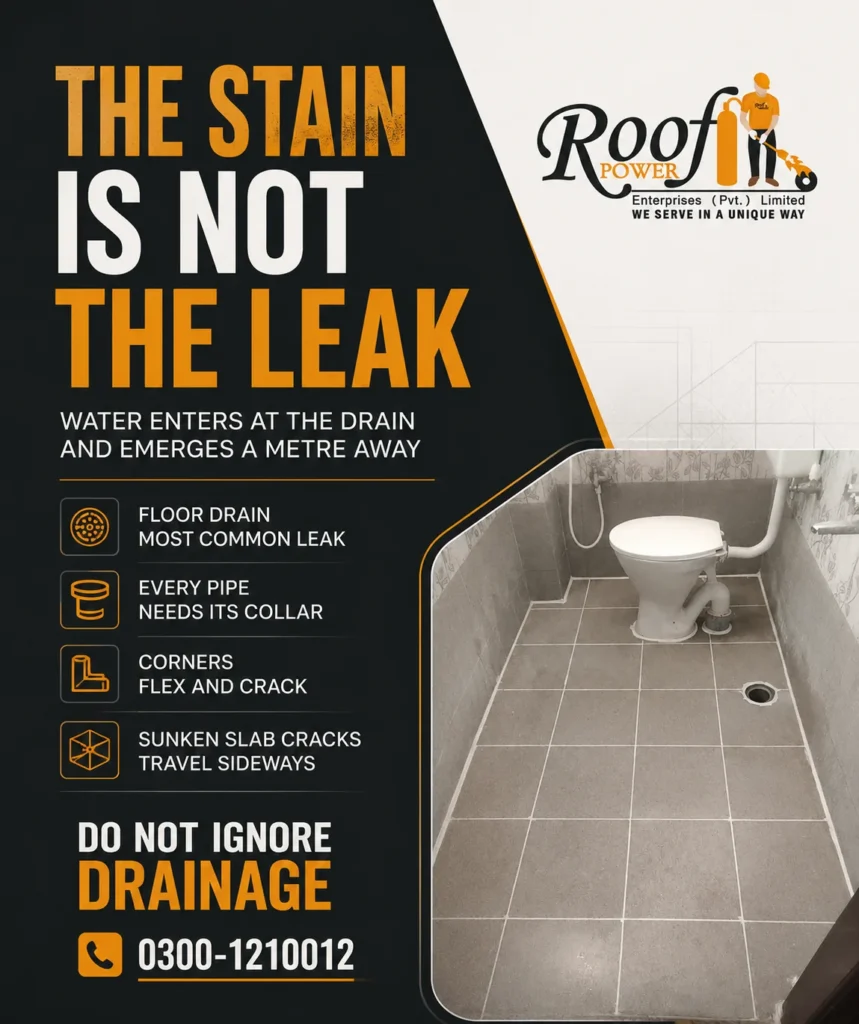
A sound, well-laid tiled floor does not leak through the middle. Water finds the weak points, and a bathroom is full of them:
The floor drain (gully). The junction where the floor meets the drain outlet is the single most common bathroom leak point. If it isn’t properly sealed with a puddle flange or correct detailing, water runs straight past the tiles and into the slab.
Pipe and WC penetrations. Every pipe that pierces the floor — the WC waste, the floor traps, concealed plumbing — is a hole through your waterproofing. Each one needs its own collar and seal. Miss one, and it leaks.
The floor-to-wall junctions. The corner where the floor meets the walls flexes and cracks over time. Waterproofing must turn up the wall (an upstand) and be reinforced at that junction. A coating that stops at the corner fails at the corner.
The shower area. The wettest zone, where water hits the walls constantly. The wall waterproofing here matters as much as the floor.
Cracks in the sunken slab. Most Pakistani bathrooms sit on a “sunken” portion — a lowered slab filled with the plumbing and screed. Cracks here let water travel sideways through the fill until it reaches the edge and drips through the ceiling below.
This is why the ceiling stain is rarely directly under the leak: water enters at the drain or a junction, travels through the sunken slab and along the concrete, and emerges wherever it finds a path — often a metre or more away. Chasing the stain never works. Finding the entry point does.
Why a Chemical Coat Over the Tiles Usually Fails
The most common “fix” sold in Pakistan is a waterproofing chemical brushed over the existing tiled floor. Sometimes it buys a little time. Usually it fails, for a simple reason: it doesn’t reach the places the water is actually getting in.
The leak is at the drain junction, under the WC, at the pipe penetrations, at the floor-to-wall corners — often below the tile surface, in the detailing. A coating painted over the top of finished tiles and grout sits on the surface, cannot properly seal a moving junction or a pipe penetration, and wears off the tile glaze it was never designed to bond to. The water simply keeps entering where it always did.
Real bathroom waterproofing is about detailing the weak points correctly — the junctions, the drain, the penetrations — with a proper membrane system, ideally as part of the floor build-up rather than a coat on top of it. That’s the difference between a leak that’s fixed and a leak that’s postponed.
Signs Your Bathroom Needs Waterproofing
- A damp patch, stain, or drip on the ceiling of the room below the bathroom
- Damp or peeling paint on a wall adjacent to, or below, a bathroom
- Efflorescence (white salt) on the ceiling or wall below
- A musty, damp smell near the bathroom or the room beneath it
- Loose, cracked, or hollow-sounding floor tiles
- Damaged, blackened, or missing grout, especially near the drain and corners
- Damp along the skirting of an adjacent room
- Water seeping under the bathroom door into the hallway
Who Needs Bathroom Waterproofing
Homeowners — the core audience — with a leaking bathroom damaging the room or ceiling below, or planning to renovate a bathroom and wanting it done right.
Apartment and plaza owners — where an upper-floor bathroom leaks into the unit below, creating disputes and repeated complaints.
Builders and developers — waterproofing bathrooms correctly at construction, before tiling, across every unit.
Hotels, guesthouses, and hostels — many bathrooms, heavy use, and leaks that damage rooms and reputation.
Contractors and renovators — bathroom waterproofing as a specialist step during a fit-out.
The Question Everyone Asks: Do You Have to Remove the Tiles?
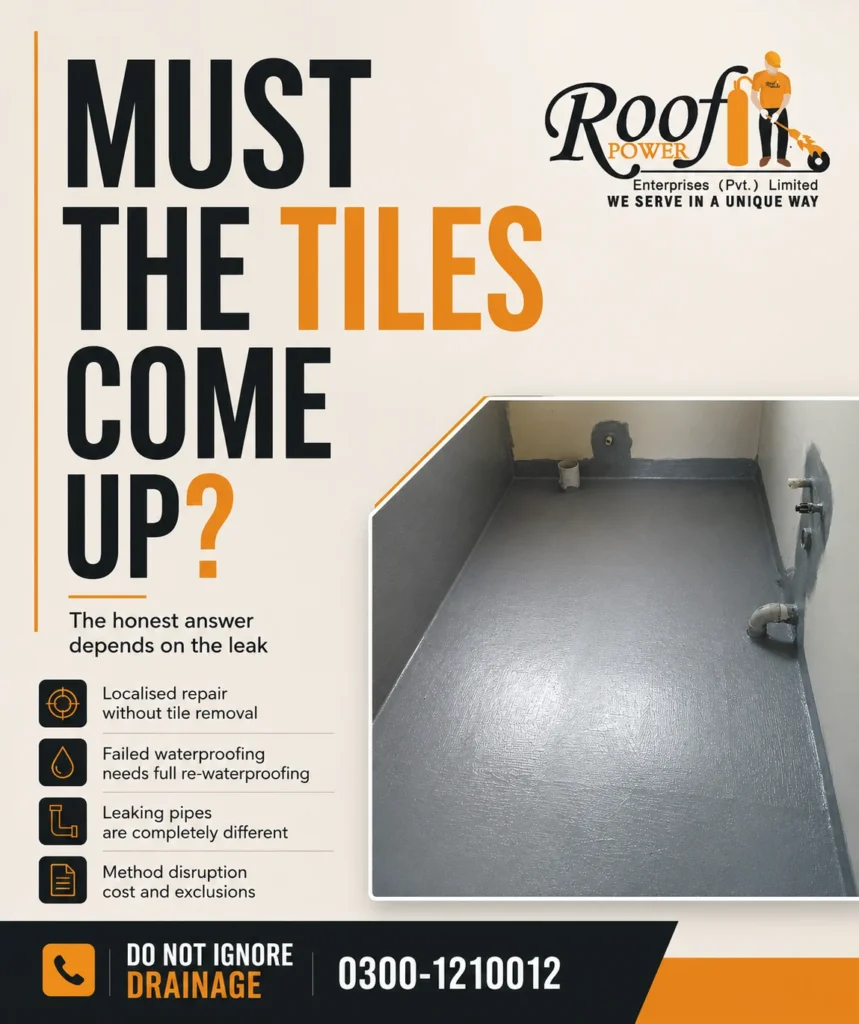
This is the fear that stops people calling — nobody wants their finished bathroom demolished. So here’s the honest answer: it depends on the leak, and we tell you at inspection.
Sometimes we can avoid removing tiles. If the leak is localised — a failed seal at the drain, a specific junction, damaged grout — targeted repair, penetrative crystalline treatment, and re-sealing the weak points can sometimes resolve it without a full rip-out.
Sometimes tiles must come up. If the waterproofing beneath the floor has failed across the wet area, or the sunken slab is cracked and leaking, no surface treatment will hold. In that case the honest answer is that the floor needs to be opened, waterproofed properly at the junctions and penetrations, and re-tiled. It costs more, but it’s the difference between fixing it and repeating it.
A contractor who promises “no tile removal, guaranteed” before seeing your bathroom is telling you what you want to hear, not what’s true. We diagnose first, tell you honestly which situation you’re in, and give you the real options.
Our Inspection
Step 1 — Trace the leak to its source. We work back from the ceiling-below damage to the actual entry point in the bathroom — drain, penetration, junction, or sunken-slab crack.
Step 2 — Rule out plumbing. Some “bathroom leaks” are actually leaking supply or waste pipes, not failed waterproofing. We check, because the fix is completely different — and we won’t waterproof over a leaking pipe.
Step 3 — Assess the existing waterproofing and tiles. Is the floor build-up sound, or has the waterproofing failed under the tiles?
Step 4 — Determine the method. Localised repair without tile removal, or full re-waterproofing with tile removal — with an honest recommendation.
Step 5 — Written recommendation. Method, whether tiles come up, materials, disruption, cost, and exclusions — in writing.
Our Methods & Materials
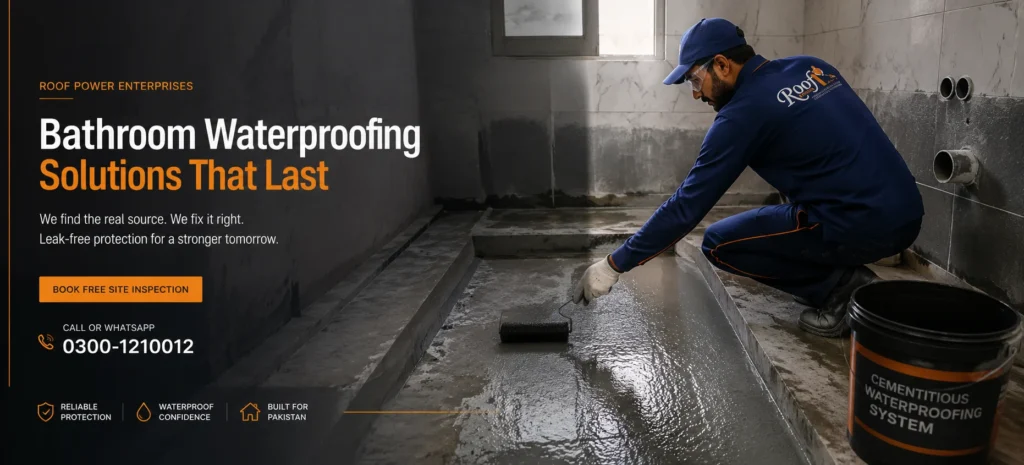
Full waterproofing (tiles removed / new or renovated bathroom). The floor is taken back to the slab. We repair cracks, form coved fillets at the floor-to-wall junctions, fit a puddle flange at the drain and collars at every penetration, apply a liquid or cementitious membrane with reinforcing fabric at all junctions, flood-test it to confirm it holds, then screed and tile over it. This is the correct, lasting way — the membrane is under the tiles where it belongs.
Targeted repair (tiles retained, where feasible). For localised leaks, we treat the specific weak points: re-seal the drain, treat penetrations, apply penetrative crystalline waterproofing, and renew grout and sealant at the junctions.
Materials: liquid-applied and polymer-modified cementitious membranes, reinforcing fabric for junctions, puddle flanges and pipe collars, crystalline waterproofing, and mould-resistant waterproof grout and sealant. The system is chosen to suit whether the floor is being opened or not.
Our Process (Full Waterproofing)
- Diagnosis and written recommendation.
- Remove tiles and screed back to the slab (wet area).
- Repair cracks and the sunken slab; check the plumbing.
- Detail the weak points — coved fillets at wall junctions, puddle flange at the drain, collars at every penetration.
- Apply the membrane with reinforcing fabric at all junctions and upstands turned up the walls.
- Flood test — pond the floor and confirm no leakage before tiling.
- Screed and re-tile with waterproof grout.
- Handover with maintenance guidance for grout and sealant.
Waterproofing During Renovation — the Smart Time to Do It
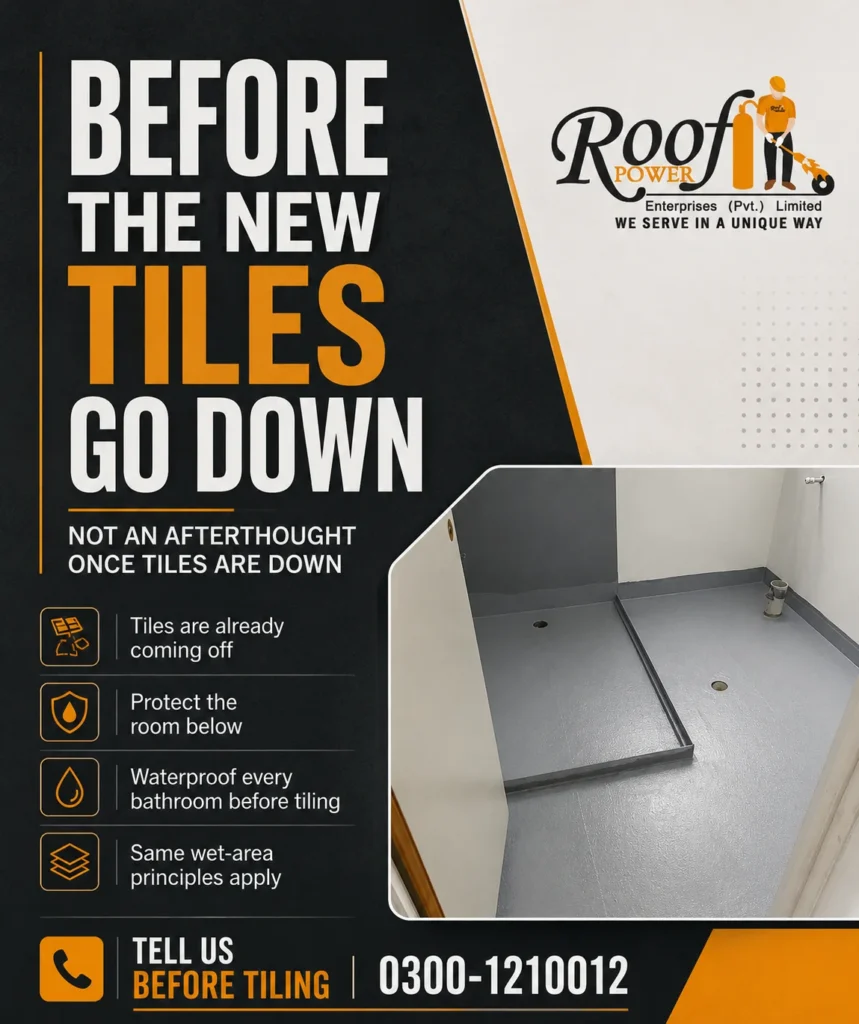
The single best time to waterproof a bathroom is when you’re renovating it anyway — because the tiles are already coming off. At that moment, waterproofing the floor and wet-area walls properly, at the junctions and penetrations, adds relatively little cost and saves you from a leak in two years’ time. If you’re planning a bathroom renovation, waterproofing should be a non-negotiable step in the middle of it, not an afterthought once the new tiles are down. Tell your contractor, or tell us, before the tiling starts.
Applications
Residential bathrooms and washrooms — the core work: stopping leaks and protecting the room below. Apartment and plaza bathrooms — resolving upper-floor leaks into units below. Hotel and hostel bathrooms — many units, heavy use. New construction — waterproofing every bathroom before tiling. Kitchens and other wet areas — the same wet-area principles apply.
Practical Project Examples
Representative examples of the situations we handle. Real Roof Power project case studies with photographs are being added to this page.
Residential — Upstairs bathroom, Lahore. Problem: A spreading damp stain on the lounge ceiling below an upstairs bathroom; the owner had repainted the ceiling twice and had a chemical coat applied over the bathroom tiles. Findings: The leak was at the floor drain junction and a WC penetration — neither reached by the surface coating. The sunken slab had carried the water two feet before it dripped through. Recommendation: Remove tiles in the wet area, fit a puddle flange and pipe collars, cove the junctions, apply a membrane, flood-test, and re-tile. Point of the story: The coating never had a chance — it wasn’t near the leak.
Apartment — Karachi. Problem: An upper-floor bathroom leaking into the flat below; an ongoing dispute between neighbours. Findings: Failed waterproofing under the shower area; cracked grout and a leaking floor-to-wall junction. Recommendation: Re-waterproof the shower wet area with proper upstands and junction reinforcement, flood-test, re-tile. Point of the story: In apartments, a bathroom leak is two households’ problem — it needs to be fixed at the source, once.
Renovation — Islamabad. Brief: A homeowner renovating a bathroom wanted it waterproofed properly this time. Approach: Full membrane system with junction and penetration detailing and a flood test, applied under the new tiles as part of the renovation. Point of the story: Done during renovation, proper waterproofing added little and removed the risk entirely.
What Affects the Cost
- Tile removal or not. The biggest variable — a localised repair with tiles retained versus a full strip-out, re-waterproof, and re-tile.
- Extent of the wet area and the number of penetrations.
- Condition of the sunken slab and any repair needed.
- Method and materials specified.
- Re-tiling and finishes where the floor is opened.
- Whether it’s part of a renovation (cheaper — the tiles are already off).
Pricing disclaimer: cost is provided in a written quotation after inspection. Whether tiles must be removed is the main driver and can only be determined on site.
Project Timeline
| Stage | Typical duration |
| Inspection & recommendation | Same day–1 day |
| Targeted repair (tiles retained) | 1–2 days |
| Full waterproofing (tiles removed) | 3–6 days incl. flood test, curing, re-tiling |
| Flood test | 24–48 hours |
| Handover | Same day |
Timelines depend heavily on whether tiles are removed and re-laid. We give you a realistic return-to-use date and won’t rush curing or the flood test — the test is what proves the job is done.
Common Mistakes
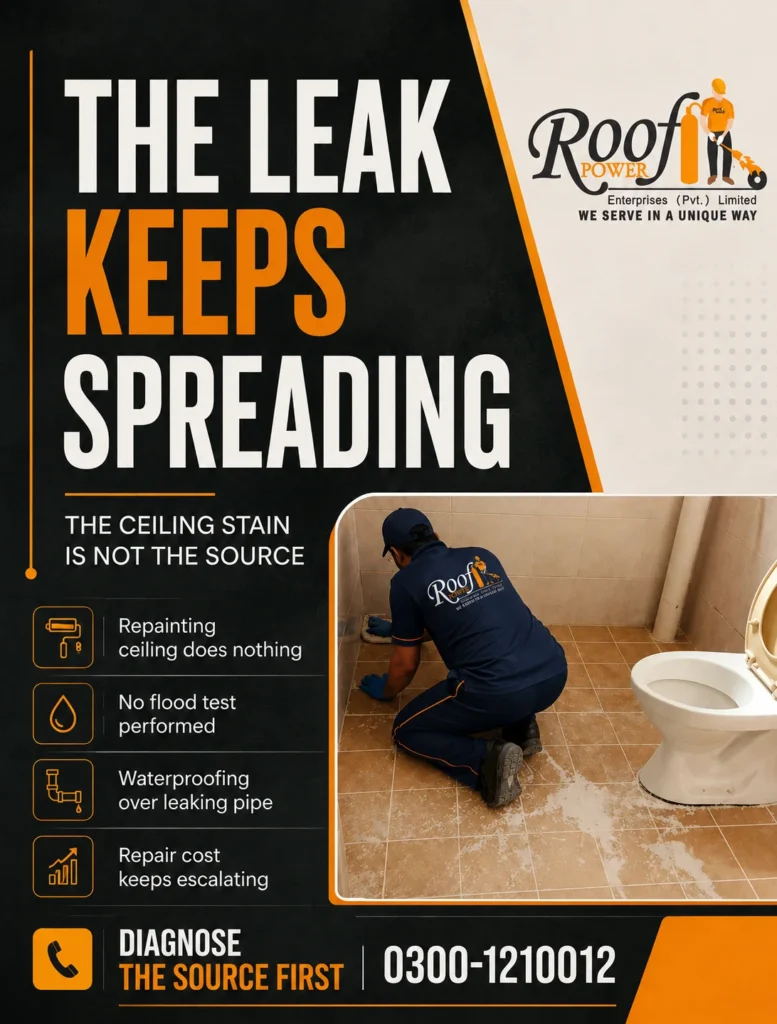
Chasing the ceiling stain instead of the source. Repainting the ceiling below does nothing; the water is coming from the bathroom above.
A chemical coat over finished tiles. It rarely reaches the drain, penetrations, or junctions where the leak actually is.
Skipping the junction and penetration detailing. The floor drain, pipe collars, and coved wall junctions are where bathrooms leak — and where cheap jobs cut corners.
No flood test. Without ponding the floor and checking, you don’t actually know it’s sealed until it leaks again.
Waterproofing over a leaking pipe. If it’s a plumbing leak, no membrane fixes it — it must be diagnosed correctly first.
Missing the renovation opportunity. Re-tiling without waterproofing underneath is a leak waiting to happen.
Risks of Ignoring a Leaking Bathroom
- Damage to the ceiling and room below — stains, peeling paint, falling plaster
- Corrosion of reinforcement in the slab over time
- Mould and fungal growth — a health issue in an enclosed home
- Damage to adjacent walls, doors, and finishes
- Disputes with neighbours in apartments and plazas
- Persistent musty smell
- Escalating repair cost as the water spreads through the structure
Honest Limitations
Some leaks are plumbing, not waterproofing. A leaking supply or waste pipe needs a plumber, not a membrane. We diagnose which it is and tell you honestly — we won’t sell you waterproofing for a pipe problem.
Sometimes tiles must come up. Where the under-tile waterproofing has failed or the sunken slab is cracked, no surface treatment will last. We’ll tell you when a proper fix means opening the floor — because the alternative is doing it again.
A surface coat is a stopgap, not a solution, in most real leaks. We’ll do it if you specifically want a temporary measure, but we’ll be clear about what it is.
Grout and sealant need maintenance. These are wear items; they need occasional renewal to keep a bathroom sound.
Nothing is permanent. Service life depends on the method, the detailing, the use, and maintenance. There’s no lifetime guarantee on a wet area in daily use.
Why Choose Roof Power Enterprises (Pvt.) Limited
- A registered private limited company — traceable and accountable.
- 8+ years across bathroom and wet-area waterproofing.
- We find the real leak source — drain, penetration, junction, or slab — not just the stain.
- We’re honest about tile removal — we tell you which situation you’re in before you commit.
- We detail the weak points properly — puddle flange, pipe collars, coved junctions, reinforced membrane — and we flood-test before tiling.
- We rule out plumbing first — so you don’t pay for waterproofing a pipe leak.
- Full building protection — bathroom, water tank, wall, roof, and below-grade — for whole-home peace of mind.
- Three offices — Lahore, Islamabad, Karachi — with nationwide coverage.
- Named leadership — CEO & Founder Muhammad Haseeb Hassan reviews technical recommendations.
Frequently Asked Questions
Why is there a damp patch on the ceiling below my bathroom?
Because the bathroom above is leaking — almost always at the floor drain, a pipe or WC penetration, or a floor-to-wall junction, not through the middle of the floor. Water enters at one of these weak points, travels through the sunken slab, and emerges on the ceiling below, often a metre from the entry point. That’s why repainting the ceiling never works: the source is in the bathroom, not the ceiling.
Do you have to remove the tiles to waterproof a bathroom?
It depends on the leak. Localised leaks — a failed drain seal, damaged grout, a specific junction — can sometimes be resolved with targeted repair and penetrative treatment without a full rip-out. But if the under-tile waterproofing has failed across the wet area, or the sunken slab is cracked, the floor must be opened and waterproofed properly. We determine which at inspection and tell you honestly.
Why does my bathroom keep leaking after being “fixed”?
Usually because the “fix” was a chemical coat brushed over the finished tiles, which doesn’t reach the drain, penetrations, and junctions where the water actually enters. Real waterproofing detailing those weak points — ideally under the tiles — is what stops it for good.
Is a chemical coat over the tiles enough to stop bathroom leakage?
Only rarely, and usually only as a temporary measure. Most bathroom leaks are at junctions and penetrations that a surface coat can’t properly seal, and it doesn’t bond well to tile glaze. It often postpones the problem rather than solving it.
How is a bathroom waterproofed properly?
For a lasting result, the floor is taken back to the slab; cracks are repaired; the floor-to-wall junctions are coved; a puddle flange is fitted at the drain and collars at every pipe penetration; a membrane with reinforcing fabric is applied and turned up the walls; the floor is flood-tested to confirm it holds; and then it’s screeded and tiled. The waterproofing sits under the tiles, where it belongs.
How much does bathroom waterproofing cost in Pakistan?
It depends mainly on whether the tiles must be removed. A localised repair with tiles retained is far cheaper than a full strip-out, re-waterproof, and re-tile. Other factors are the size of the wet area, the number of penetrations, slab repair, and finishes. We provide a written quotation after inspection.
Can a bathroom be waterproofed without breaking it?
Sometimes — for localised leaks, with targeted repair and penetrative crystalline treatment. But where the waterproofing has failed under the floor, a durable fix means opening it. Anyone guaranteeing “no breaking” before seeing your bathroom is guessing.
Is my ceiling leak a bathroom problem or a plumbing problem?
It could be either — a failed waterproofing detail, or a leaking supply/waste pipe. They need completely different fixes, so diagnosis comes first. We check for plumbing leaks before recommending waterproofing, so you don’t pay for the wrong solution.
Should I waterproof my bathroom during a renovation?
Absolutely — it’s the ideal time, because the tiles are already off. Waterproofing the floor and wet-area walls properly during a renovation adds relatively little cost and prevents future leaks. It should be a standard step before the new tiles go down.
Which cities do you serve?
Our offices are in Lahore, Islamabad, and Karachi, and we deliver bathroom waterproofing across Pakistan.
A Note from the Founder

A leaking bathroom is the most common waterproofing problem we see, and also one of the most misunderstood — because the damage never shows up where the leak is. Someone calls about a stain on their lounge ceiling, and the real problem is a drain seal in the bathroom above.
The mistake I see again and again is a chemical coat brushed over the tiles. It looks like a fix. It costs a little. And it almost never works, because the water is getting in at the drain, at the pipes, at the corners — places a coat on top of the tiles simply can’t reach. So the ceiling below gets stained again, and the homeowner feels cheated.
When my team looks at a bathroom, the first job is to trace the leak back to where the water actually enters, and to rule out a plumbing leak, and then to tell you honestly whether we can fix it without lifting the tiles or whether the floor needs opening. Sometimes the honest answer costs more than you hoped. But we’d rather fix it once than take your money twice.
If your ceiling is telling you the bathroom above is leaking, let us find the real source.
Muhammad Haseeb Hassan CEO & Founder, Roof Power Enterprises (Pvt.) Limited
Book Your Free Bathroom Leak Inspection
If a ceiling below your bathroom is stained or dripping, or you’re renovating and want it waterproofed properly — let us trace the real source and tell you honestly what it needs.
Call or WhatsApp: 0300-1210012 Email: roofpowers@gmail.com
Our offices: Lahore — Office No.1, Millat Tractor Cooperative Housing Society, New Defence Road Islamabad — Office No.3, Roshan Plaza, Sector H-13 Karachi — 2nd Floor, Hassan Square, Gulshan-e-Iqbal
Renovating a bathroom? Ask us to waterproof it while the tiles are off — the smart, low-cost time to do it right. Builder or developer? We waterproof bathrooms to specification across whole projects, before tiling.
Roof Power Enterprises (Pvt.) Limited — Registered Private Limited Company · 8+ Years · Waterproofing & Building Protection Across Pakistan.
Disclaimers. Recommendations are subject to physical inspection and leak-source diagnosis. Whether tiles must be removed depends on the leak source and condition and is determined at inspection. Some bathroom leaks are plumbing (supply/waste pipe) leaks, which are diagnosed and addressed separately. Effective waterproofing depends on correct junction, drain, and penetration detailing over a sound substrate. Pricing is provided in a written quotation after inspection. Warranty terms depend on method and scope and are stated in the quotation.