
Foundation Waterproofing Services in Pakistan
Roof Power Enterprises (Pvt.) Limited · Registered Private Limited Company · 8+ Years · Lahore · Islamabad · Karachi · Nationwide Call or WhatsApp: 0300-1210012 — Free Foundation Inspection
Quick Answer
Foundation waterproofing protects the structural base your entire building stands on — the footings, foundation walls, and plinth — from groundwater and rising damp. Left unprotected, that moisture corrodes the foundation’s steel, weakens the structure over time, and wicks up into your ground-floor walls as damp with no obvious source. It is dramatically cheaper to do during construction, with exterior membrane tanking applied before the earth is backfilled, than to retrofit it later by digging the foundation back up. For existing buildings, we use crystalline systems, damp-proofing, and drainage. Either way, we inspect and diagnose first.
What Foundation Waterproofing Actually Is
To be clear from the outset: this page is about building foundations — the concrete structural base a building sits on — not cosmetics. Foundation waterproofing is the protection of that base against the water in the ground around and beneath it.
Your foundation is the most important part of your building and the part you can never see once construction is finished. It carries the entire weight of the structure, and it sits permanently in the earth — which, in a Pakistani monsoon or in a high-water-table area, is often saturated with water. That water attacks the foundation in two ways at once: it presses against it under hydrostatic pressure, and it wicks upward into the concrete by capillary action (the effect that draws water up a dry sponge). Foundation waterproofing stops both.
Roof Power Enterprises (Pvt.) Limited is a registered Pakistani building protection company. We waterproof foundations for new construction and for existing buildings across Pakistan, with offices in Lahore, Islamabad, and Karachi — and we always inspect and diagnose before we recommend.
Why Foundation Waterproofing Matters More Than People Think
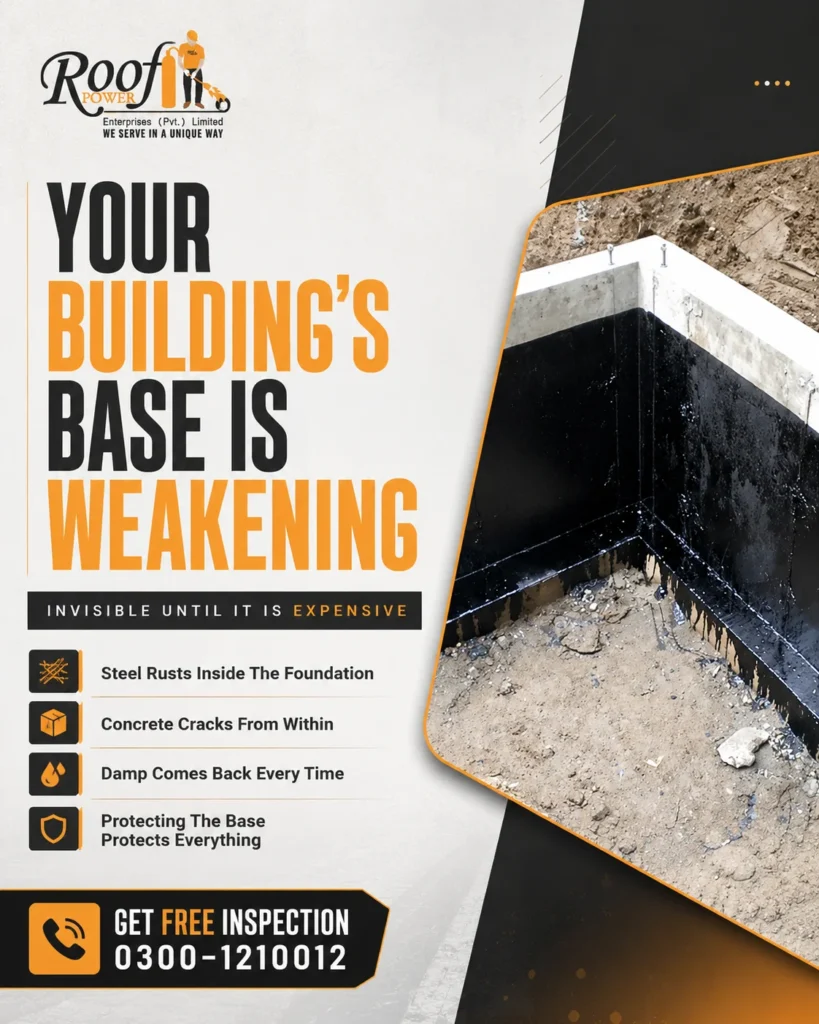
A foundation problem is invisible until it is expensive. Here is what unprotected moisture does to it:
It corrodes the reinforcement. A foundation is reinforced concrete. When water reaches the steel inside, the steel rusts, and rusting steel expands and cracks the concrete from within. This is slow, hidden, and structurally serious — it is your building’s base that is weakening.
It causes rising damp in the walls above. This is the symptom most people actually notice. A wet foundation wicks moisture upward into the ground-floor walls, producing damp patches, peeling paint, and efflorescence a metre or more up the wall — with no leak anywhere in sight. People spend a fortune replastering and repainting those walls, and the damp comes back every time, because the source is in the foundation, not the wall.
It degrades the concrete. Constant moisture, and the salts it carries, break down concrete over years.
It threatens the whole building. Everything above the foundation depends on it. Protecting the base protects the entire structure.
And here is the fact that matters most, especially if you are building:
The Construction-Stage Advantage — Do It Now, or Pay Many Times More Later
Foundation waterproofing is the clearest “do it now” decision in all of construction.
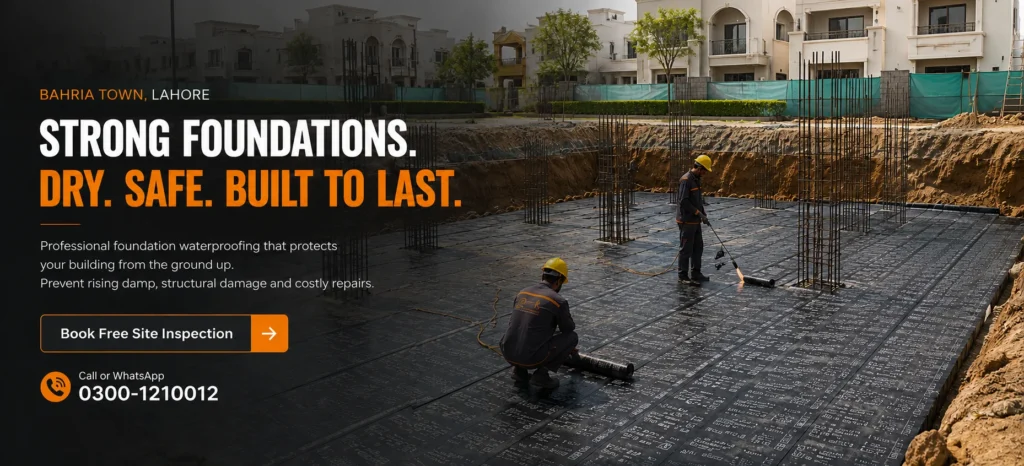
When a foundation is being built, its outside face is exposed and accessible. Applying a waterproof membrane to that outside face — exterior, positive-side tanking — before the earth is backfilled against it is straightforward, fast, and relatively inexpensive. The water is stopped at the source, on the outside, before it ever reaches the concrete. This is the gold standard, and at construction stage it is easy.
Once the building is up and the earth is backfilled, that same outside face is buried under tonnes of soil, often under paving, boundary walls, and landscaping. Reaching it again means excavating around the building — a major, expensive, disruptive operation. The exact same waterproofing that was cheap and simple at construction is now a serious undertaking.
For builders and developers, the message is simple: waterproof the foundation before you backfill. It costs a fraction of the remedial alternative, it protects your reputation from callbacks, and it protects the building for its whole life. Skipping it to save a small sum at construction is one of the most expensive false economies in the trade — and it is, unfortunately, extremely common in Pakistan.
Why Foundations Take On Water
High water table or saturated soil. Where groundwater sits high, or the monsoon saturates the ground, the foundation is effectively standing in water.
No waterproofing at construction. The most common cause by far — the foundation was never protected, so the porous concrete is the only barrier.
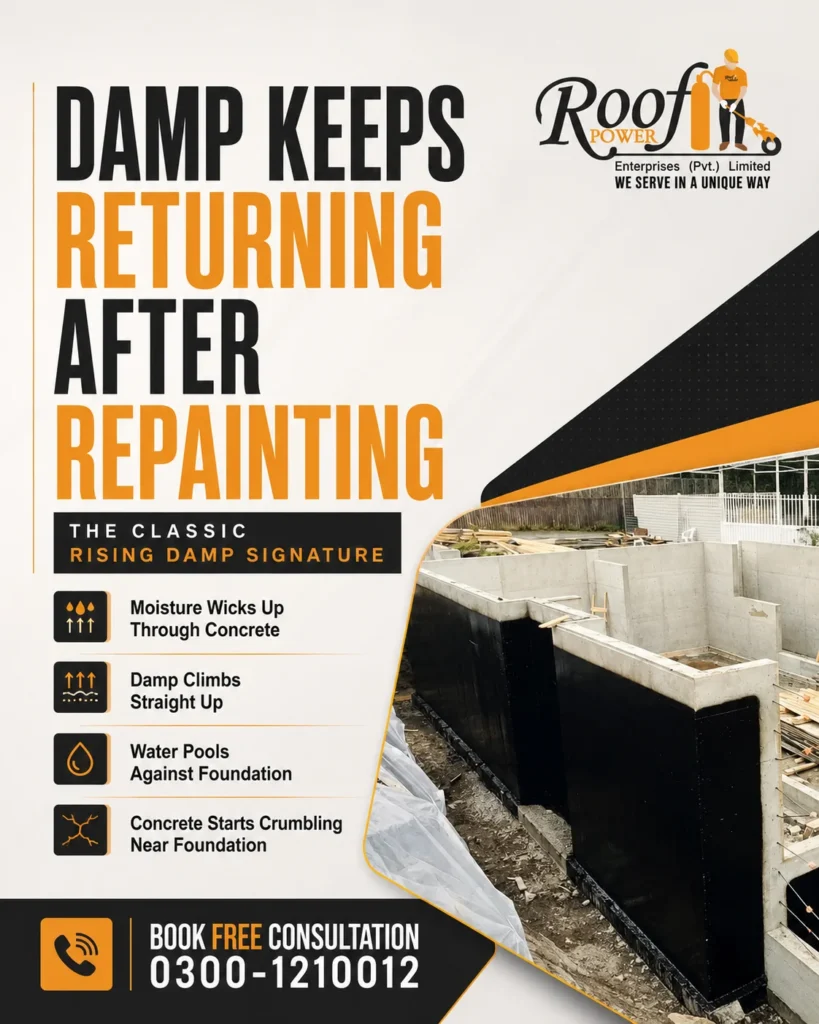
Capillary rise (rising damp). Moisture wicks up through the concrete from the wet ground, even without standing water.
Cracks and construction joints. Shrinkage cracks and un-sealed joints let water in under pressure.
Poor drainage around the building. Without drainage to carry water away from the foundation, water pools against it.
Failed or absent DPC. The damp proof course is the horizontal barrier that stops rising damp crossing from the foundation into the walls. If it is missing, failed, or bridged, damp climbs straight up.
Signs Your Foundation Needs Waterproofing
- Damp patches rising up ground-floor walls, often with a “tide mark”
- Peeling paint or bubbling plaster low on the walls
- White salt deposits (efflorescence) near the base of walls
- A musty, damp smell at ground-floor level
- Damp or water at the plinth or where the wall meets the floor
- Deteriorating or crumbling concrete at the foundation/plinth
- Damp that keeps returning after repainting — the classic rising-damp signature
Who Needs Foundation Waterproofing
Builders and developers — the primary audience. Waterproof the foundation at construction stage, before backfill, on every project. Cheaper, faster, and it protects your handover.
Homeowners with rising damp — where damp is climbing ground-floor walls and repainting never fixes it.
Architects and consulting engineers — specifying below-grade protection with documentation.
Owners of buildings in wet ground — high-water-table sites and areas prone to monsoon saturation.
Factory and commercial building owners — protecting structural bases and ground-floor slabs from moisture.
Our Foundation Inspection
We do not quote foundation waterproofing over the phone.
Step 1 — Establish the stage. New construction (accessible, before backfill) or existing building (buried, remedial)? This changes everything about method and cost.
Step 2 — Diagnose the moisture. Rising damp, hydrostatic seepage, or both? Where is it appearing, and is there a high water table?
Step 3 — Assess access. On an existing building, can the exterior be excavated, or must we work from inside and manage rising damp with DPC and drainage?
Step 4 — Structural check. Are cracks stable or a sign of foundation movement/settlement? Settlement is a structural-engineering matter first, and we will tell you so honestly.
Step 5 — Drainage assessment. Is water being carried away from the foundation, or pooling against it?
Step 6 — Written recommendation. Method, materials, drainage, disruption, cost, and exclusions — in writing.
Our Methods

New construction — exterior membrane tanking (the gold standard). On the accessible outside face of the foundation before backfill, we apply bitumen or HDPE membrane, protect it with a drainage/protection board, seal all joints with water stoppers, and ensure a proper DPC at the plinth to break rising damp. This is the correct, cheapest, most durable way to waterproof a foundation — and it is only easy at this stage.
Existing buildings — remedial systems. Where excavation is possible, exterior tanking can still be applied. Where it is not, we work with: – Crystalline waterproofing that penetrates and seals the concrete from within, – Cementitious coatings on accessible surfaces, – DPC installation or injection to create a capillary break and stop rising damp climbing into the walls, – Perimeter drainage to carry water away from the foundation and relieve pressure.
Foundation repair and waterproofing. Where the concrete has already been damaged by moisture, repair and waterproofing go together — fix the damage, then protect against its cause.
Materials
Bitumen and HDPE membranes for exterior tanking; crystalline and cementitious systems for penetrative and negative-side protection; DPC membrane for the capillary break at the plinth; PVC water stoppers for construction joints; dimple drainage sheet and perimeter drains for water management. The right combination depends on the diagnosis — we specify on merit, not on stock.
Our Process
- Diagnosis and written recommendation.
- Preparation — clean and prepare the foundation surface; excavate if remedial and access allows.
- Repair — treat cracks, joints, and any moisture-damaged concrete.
- Waterproofing — exterior membrane tanking (new build) or crystalline/cementitious + DPC (remedial).
- DPC / capillary break at the plinth to stop rising damp.
- Drainage — protection board and perimeter drainage where needed.
- Backfill (new build) over the protected, drained foundation.
- Handover with maintenance guidance.
Applications
New residential and commercial construction — the ideal case: foundation tanking before backfill. Existing homes with rising damp — remedial DPC, crystalline treatment, and drainage. Commercial and industrial buildings — protecting structural bases and ground-floor slabs. Buildings on wet or high-water-table ground — where foundation protection is essential, not optional.
Practical Project Examples
Representative examples of the situations we handle. Real Roof Power project case studies with photographs are being added to this page.
New construction — House foundation, Islamabad. Brief: A builder wanted the foundation waterproofed correctly before backfill. Approach: Exterior bitumen membrane tanking on the outside face of the foundation walls, protection board, water stoppers at all joints, and a proper DPC at the plinth — all completed before the earth went back. Point of the story: Done at this stage, it was fast and inexpensive. The same protection retrofitted in five years would have cost many times more.
Remedial — Rising damp, Lahore. Problem: Damp climbing a metre up the ground-floor walls of an older house; the owner had repainted twice and it kept coming back. Findings: No functioning DPC; moisture wicking up from an unprotected foundation. Exterior excavation was blocked by boundary walls. Approach: DPC injection to create a capillary break, crystalline treatment of accessible foundation surfaces, and improved perimeter drainage. Point of the story: The walls were never the problem. The foundation and the missing DPC were.
Commercial — Factory base, Karachi. Problem: Moisture and efflorescence at the base of walls and the ground-floor slab; a high local water table. Approach: Crystalline treatment, DPC works, and a perimeter drainage system sized for the water table. Point of the story: On a high-water-table site, drainage is central — protecting the base means managing the water around it.
What Affects the Cost
- New-build vs remedial. The single biggest driver. At construction, before backfill, it is a fraction of the cost. Retrofitting means excavation and is far more expensive.
- Access. Whether the foundation exterior can be reached.
- Extent of the problem. Localised rising damp versus a whole foundation in wet ground.
- Drainage. Whether perimeter drainage is required.
- Structural repair. Any moisture-damaged concrete to reinstate.
- Method and materials specified.
Pricing disclaimer: cost is provided in a written quotation after inspection. The new-build-vs-remedial difference is large, which is exactly why it pays to do it at construction.
Project Timeline
| Stage | Typical duration |
| Inspection & recommendation | 1–2 days |
| Excavation (remedial only) | Varies with access/depth |
| Preparation & repair | 1–3 days |
| Waterproofing application | 2–4 days |
| DPC / drainage | 1–3 days |
| Backfill (new build) | Varies |
| Handover | 1 day |
New-build foundation waterproofing fits neatly into the construction sequence with little added time. Remedial work takes longer because of excavation or the need to treat rising damp from inside.
Common Mistakes
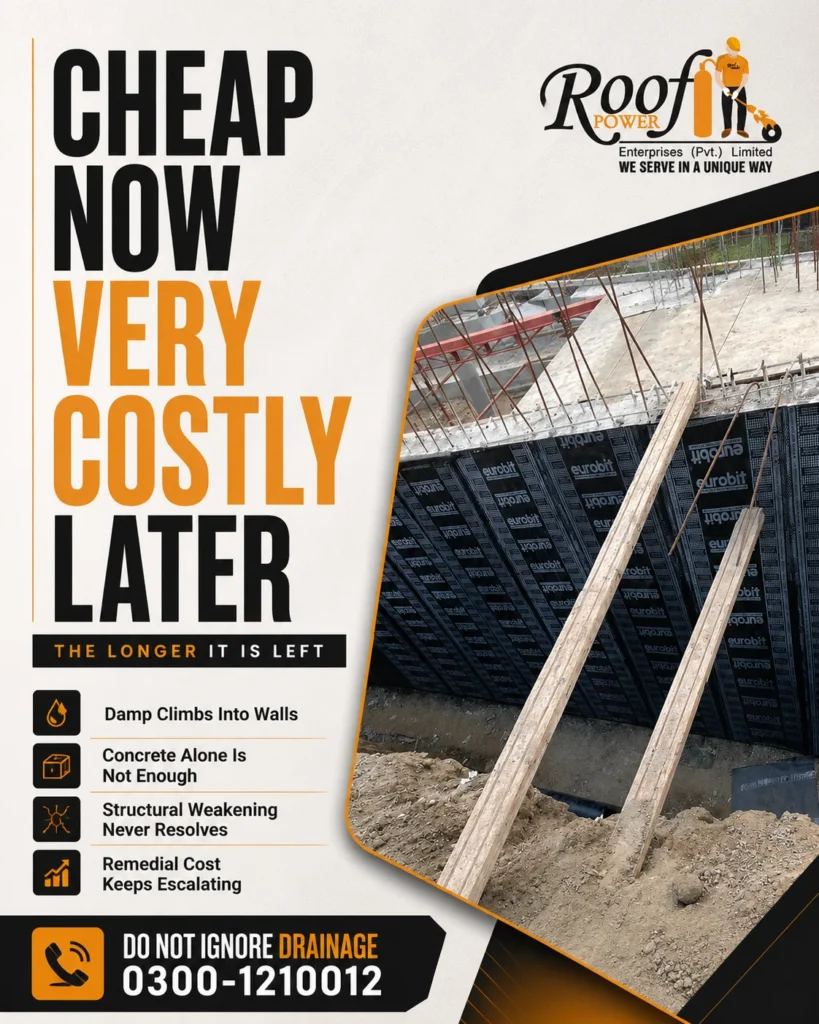
Skipping it at construction to save money. The most expensive mistake in the whole topic. What is cheap now is very costly later.
Treating rising damp as a wall problem. Replastering and repainting the wall does nothing if the source is an unprotected foundation and a missing DPC.
No DPC / capillary break. Without it, damp climbs straight from the foundation into the walls.
Ignoring drainage. Water pooling against the foundation keeps attacking it.
Coating over a structural crack. Foundation movement needs an engineer first.
Assuming the concrete alone is enough. Concrete is porous. Unprotected, it is not a waterproof barrier.
Risks of Ignoring It
- Corrosion of foundation reinforcement and structural weakening
- Persistent rising damp in ground-floor walls that never resolves
- Deteriorating foundation concrete
- Mould, musty air, and ruined finishes at ground-floor level
- Falling property value
- Escalating remedial cost — the longer it is left, the worse and dearer it gets
Honest Limitations
Waterproofing is not structural repair. If your foundation is settling, moving, or structurally cracked, that needs a structural engineer first. Waterproofing follows structural repair; it does not replace it.
Remedial is never as good, or as cheap, as construction-stage. Once a foundation is buried, the ideal exterior solution may be impractical, and we work with the best achievable remedial approach. This is precisely why doing it at construction matters so much.
Rising damp treatment takes time to show. After a DPC intervention, walls that have been saturated for years need time to dry out before the improvement is fully visible.
Drainage needs maintenance. Perimeter drains must be kept clear to keep working.
Nothing is permanent. Service life depends on the method, the application, ground conditions, and maintenance. Any lifetime guarantee on below-grade work is a marketing claim, not an engineering one.
Why Choose Roof Power Enterprises (Pvt.) Limited
- A registered private limited company — traceable and accountable.
- 8+ years in below-grade and structural waterproofing.
- We diagnose before we recommend — rising damp, hydrostatic seepage, or both.
- We understand the rising-damp chain — foundation → DPC → walls — and treat the source, not the symptom.
- New-build and remedial — the right approach for your stage, honestly advised.
- Full material range — membrane, crystalline, cementitious, DPC, drainage, water stoppers.
- We work with builders and developers to specification, with documentation.
- Three offices — Lahore, Islamabad, Karachi — with nationwide coverage.
- Named leadership — CEO & Founder Muhammad Haseeb Hassan reviews technical recommendations.
Frequently Asked Questions
Does a foundation need waterproofing?
Yes — especially in Pakistan, where monsoon saturation and high water tables are common. An unprotected foundation absorbs groundwater, which corrodes its reinforcement, degrades the concrete, and wicks up into the ground-floor walls as rising damp. Waterproofing protects the structural base of the whole building.
What is rising damp, and does foundation waterproofing stop it?
Rising damp is moisture wicking upward from a wet foundation into the walls above by capillary action, showing as damp patches and efflorescence low on ground-floor walls. Foundation waterproofing, combined with a proper damp proof course (DPC) that creates a capillary break, stops it at the source — which is why replastering the wall alone never works.
Should foundation waterproofing be done during construction?
Yes, wherever possible. At construction stage the foundation’s outside face is accessible, so exterior membrane tanking can be applied cheaply and quickly before backfill. Retrofitting the same protection later requires excavating around the building and costs many times more. Waterproofing at construction is one of the best-value decisions in building.
What is the difference between foundation and basement waterproofing?
Foundation waterproofing protects the structural base a building sits on — footings, foundation walls, and plinth — and focuses on rising damp and protecting the structure. Basement waterproofing protects a usable below-ground space — its walls and floor — from seepage and flooding under pressure. They overlap and are often done together, but they address different parts of the building.
How much does foundation waterproofing cost in Pakistan?
It depends heavily on whether it is done at construction (far cheaper, before backfill) or as a remedial job (excavation makes it more expensive), plus access, the extent of the problem, drainage, and materials. We provide a written quotation after inspection.
Can an existing foundation be waterproofed?
Yes. Where the exterior can be excavated, membrane tanking can be applied. Where it cannot, we use crystalline systems, DPC installation or injection to stop rising damp, and perimeter drainage. It is more involved than construction-stage work, but existing foundations can absolutely be protected.
What is the best foundation waterproofing membrane?
For exterior tanking, bitumen and HDPE membranes are the common robust choices, selected for the ground conditions. For existing structures where a membrane cannot be applied externally, crystalline systems that penetrate the concrete are often more appropriate. The right choice depends on the diagnosis.
Does foundation waterproofing stop damp in my walls?
If the wall damp is rising damp from the foundation — which is common — then yes, treating the foundation and installing a proper DPC addresses the actual source. If the damp has another cause (a leaking pipe, penetrating damp from outside), that is diagnosed separately. This is why we inspect before recommending.
Do you work with builders on new construction?
Yes. Builders and developers are a core audience. We waterproof foundations to specification before backfill, provide documentation, and help protect your handover against future damp callbacks.
Which cities do you serve?
Our offices are in Lahore, Islamabad, and Karachi, and we deliver foundation waterproofing across Pakistan.
A Note from the Founder

Foundation waterproofing is the decision I most wish builders in Pakistan would take more seriously — because it is so cheap to get right, and so expensive to get wrong.
When a foundation is being built, protecting it is simple. The outside is right there; you apply the membrane, you seal the joints, you set the DPC, you backfill over it, and that building’s base is protected for its whole life. It costs very little at that moment. Skip it, and five years later that same protection means digging up the entire perimeter of the house. The cost multiplies many times over.
And the damp that follows a skipped foundation is the damp I see most often — creeping up ground-floor walls, coming back after every repaint, driving people to spend money on the walls when the problem was always in the base. We treat the source: the foundation and the DPC.
If you are building, waterproof the foundation now. If you already have rising damp, let us find where it’s really coming from.
Muhammad Haseeb Hassan CEO & Founder, Roof Power Enterprises (Pvt.) Limited
Book Your Free Foundation Inspection
Whether you are building and want the foundation protected before backfill, or you have rising damp climbing your walls — let us diagnose it and tell you honestly what it needs.
Call or WhatsApp: 0300-1210012 Email: roofpowers@gmail.com
Our offices: Lahore — Office No.1, Millat Tractor Cooperative Housing Society, New Defence Road Islamabad — Office No.3, Roshan Plaza, Sector H-13 Karachi — 2nd Floor, Hassan Square, Gulshan-e-Iqbal
For builders, developers, and architects: request a construction-stage foundation waterproofing consultation. We work to specification, coordinate with your build programme, and provide documentation.
Roof Power Enterprises (Pvt.) Limited — Registered Private Limited Company · 8+ Years · Waterproofing & Building Protection Across Pakistan.
Disclaimers. Recommendations are subject to physical inspection and diagnosis. Method selection depends on the water table, access, construction stage, and structure. Foundation settlement, movement, or structural cracking requires engineering assessment; waterproofing does not repair structural defects. Pricing is provided in a written quotation after inspection. Warranty terms depend on method and scope and are stated in the quotation. Excavation and confined-space work follow site safety protocols.