Basement Waterproofing Services in Pakistan | No More Damp
Roof Power Enterprises (Pvt.) Limited · Registered Private Limited Company · 8+ Years · Lahore · Islamabad · Karachi · Nationwide Call or WhatsApp: 0300-1210012 — Free Basement Inspection
Quick Answer
A wet basement is not like a leaking roof. Underground, water pushes against your walls and floor from every direction under constant hydrostatic pressure — so it finds every crack, joint, and pore. Fixing it means diagnosing where the water comes from and how much pressure it is under, then choosing the right method: exterior waterproofing (the most durable, but it needs digging), interior systems (less disruptive, but limited under heavy pressure), or a combination with drainage. At Roof Power, we inspect first and recommend honestly — because the wrong method on a basement is money you will spend twice.
Basement Flooding Right Now?
If your basement is actively taking on water, the priorities are safety and containment first: keep clear of standing water near electrical points, and if it is safe, remove valuables and use a pump to reduce the level. Then call us — a flooding basement is diagnosed as an emergency, not scheduled for next week. Call or WhatsApp 0300-1210012.
For everyone dealing with chronic damp, seepage, or a basement that floods every monsoon, the rest of this page explains exactly what is happening and how it is properly fixed.
Why a Basement Is a Completely Different Problem From a Roof
Most waterproofing companies treat a basement like a roof turned upside down. It is not, and that misunderstanding is why so many basement treatments fail.
A roof deals with water that rests on a surface and then drains away. Gravity is on your side; the water wants to leave. You stop it with a barrier on top, and the job is largely done.
A basement deals with water that surrounds the structure and pushes inward — from the walls, from the floor, from below — under hydrostatic pressure. When the ground around your basement is saturated (which, in a Pakistani monsoon or in a high-water-table area of Karachi, is often), that water column exerts continuous force against every square inch of your basement, looking for any way in. It does not want to leave. It is being pushed.
This changes everything:
- Water finds the smallest crack, the tiniest pore, every construction joint.
- A coating that simply sits on the inside face has water pressing behind it, trying to lift it off.
- The problem is not seasonal in the way a roof leak is — the pressure returns every time the ground saturates.
Understanding hydrostatic pressure is the whole key to basement waterproofing. Once you understand it, the single most important decision — do we stop the water outside, or manage it inside? — starts to make sense.
Why Basements Leak
Our engineers inspect for these root causes:
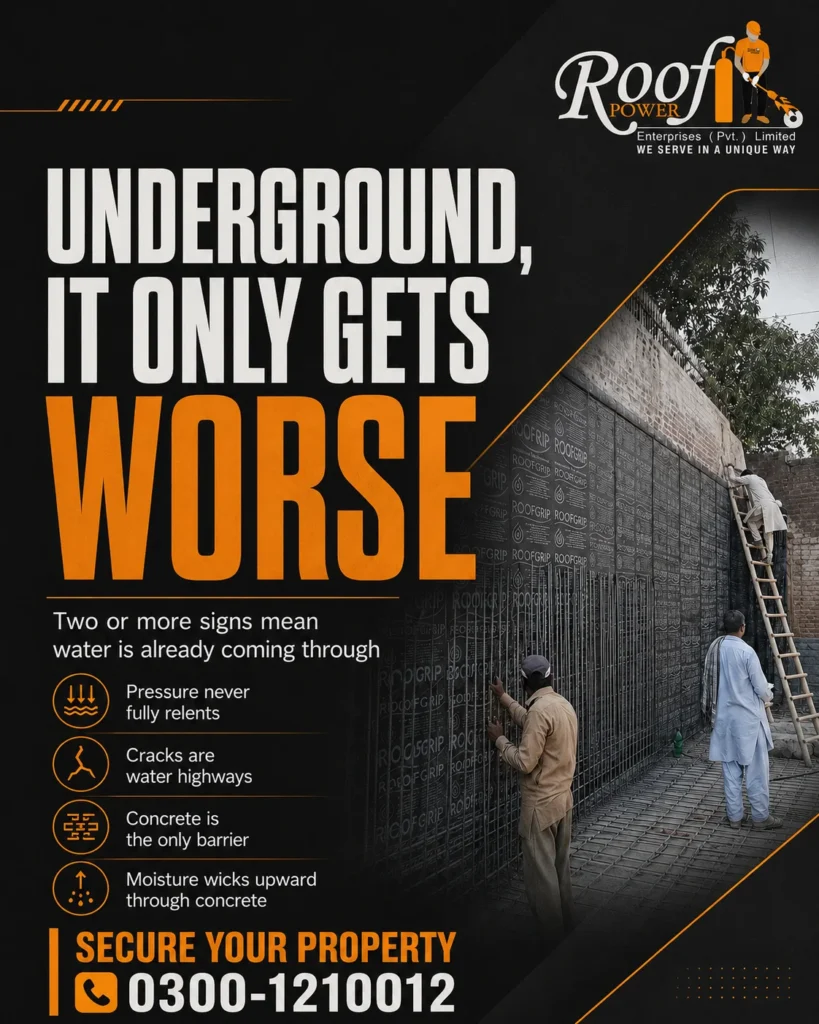
High water table or saturated soil. Where the natural groundwater level is high, or the monsoon saturates the surrounding earth, the basement sits in water and the pressure never fully relents.
Cracks in the walls or floor slab. Shrinkage cracks, settlement cracks, and construction joints are the highways water uses to enter under pressure.
Failed or absent exterior waterproofing. If the structure was never properly waterproofed on the outside during construction — which is common — the concrete itself is the only barrier, and concrete is porous.
Poor or missing drainage. Without a way to relieve the water pressure around the basement, the full hydrostatic head bears on the structure.
Construction and expansion joints without water stops. Joints are deliberate breaks in the concrete; without a PVC water stopper cast in, they leak.
Capillary rise (rising damp). Moisture wicks upward through the concrete from the wet ground, producing damp walls even without visible water.
Signs Your Basement Needs Waterproofing
- Damp patches or water stains on basement walls or floor
- Standing water or puddles after rain
- White salt deposits (efflorescence) on the walls
- A persistent musty or damp smell
- Mould or fungal growth on walls, corners, or stored items
- Peeling paint or bubbling plaster below ground level
- Water seeping up through the floor slab
- Rusting of anything metal stored in the basement
- A finished basement you can no longer use because of moisture
Two or more of these mean water is already coming through. Underground, it only gets worse.
Who Needs Basement Waterproofing
Homeowners and villa owners with basements used for living space, storage, home theatres, gyms, or parking — where damp makes the space unusable and threatens the structure.
Builders and developers waterproofing basements correctly at construction stage — far cheaper and more reliable than remedial work after handover.
Architects and consulting engineers requiring below-grade waterproofing to specification with documentation.
Commercial building owners with underground car parks, plant rooms, and storage — where leakage is a liability and a maintenance drain.
Factory owners with below-grade storage, pits, or tanks.
Our Basement Inspection & Diagnosis
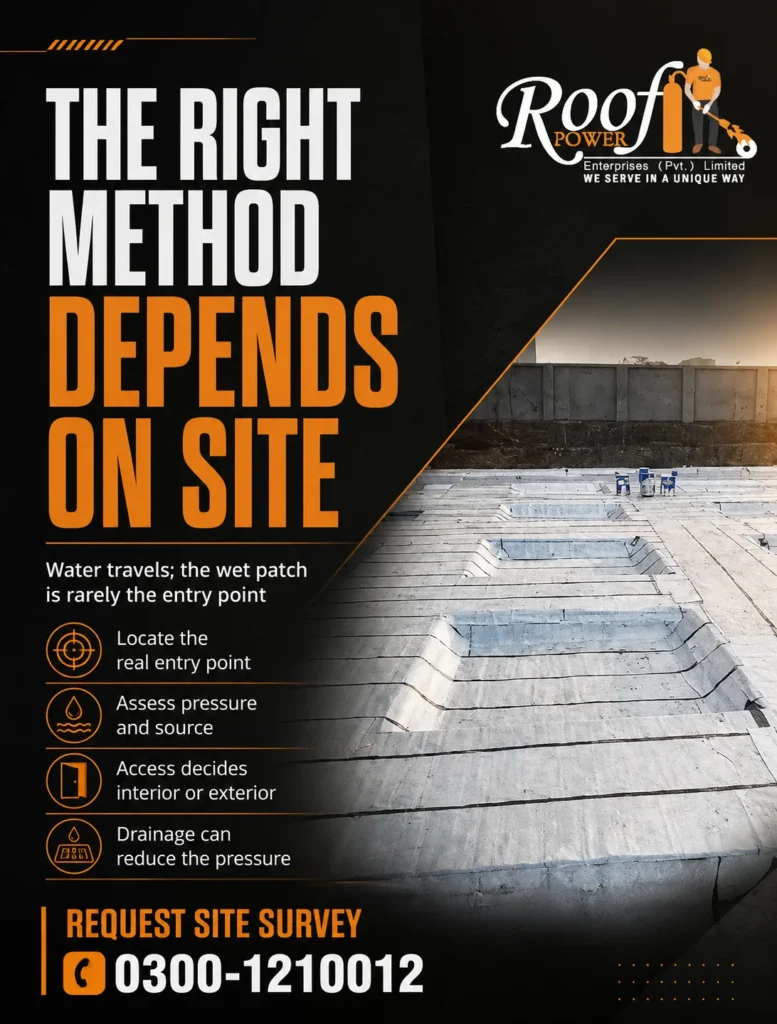
We do not quote basement waterproofing over the phone, because the right method depends entirely on things you can only assess on site.
Step 1 — Locate the water. Where is it entering — walls, floor, joints, a specific corner? Water travels, so the wet patch is rarely the entry point.
Step 2 — Assess the pressure and source. Is this seepage, capillary damp, or water under real hydrostatic pressure? Is there a high water table? Does it worsen after rain? This determines whether a surface treatment can work or whether pressure must be managed.
Step 3 — Assess access. Can the exterior be excavated, or is the basement surrounded by other structures, boundary walls, or paving? Access often decides interior vs exterior as much as engineering does.
Step 4 — Structural check. Are the cracks stable shrinkage cracks (a waterproofing matter) or active structural cracks (an engineering matter first)? We will tell you honestly which you have.
Step 5 — Drainage assessment. Is there any relief drainage? Would a sump and pump, or a perimeter drain, reduce the pressure the waterproofing has to resist?
Step 6 — Written recommendation. The method (interior, exterior, or combined), the materials, the drainage, the disruption, the cost, and the exclusions — in writing.
The Key Decision: Interior vs Exterior
This is the single most important choice in basement waterproofing, and it is the one almost no Pakistani competitor explains. Get it right and the basement stays dry for years. Get it wrong and you pay twice.
| Exterior (Positive Side) | Interior (Negative Side) | |
| Where it works | On the outside face of the structure — where the water actually is | On the inside face — after the water has reached the wall |
| Principle | Stops water before it enters the concrete | Manages/blocks water from inside the structure |
| Durability | Highest — the water never enters the structure | Good, but works against the pressure rather than with it |
| Disruption | High — requires excavation around the basement | Low — no digging; done from inside |
| Best for | New construction; accessible exteriors; severe water/pressure | Existing basements where the exterior can’t be dug; moderate seepage; finished spaces |
| Typical materials | Bitumen / HDPE membrane, protection board, drainage sheet | Crystalline waterproofing, cementitious slurry, injection grouting |
| Cost | Higher (excavation) | Generally lower |
| Honest limit | Not always possible — the exterior may be inaccessible | Under very high hydrostatic pressure, a negative-side coating can be pushed off; drainage often needed alongside |
The honest truth: exterior waterproofing is the gold standard because it stops water at the source — but it is not always possible on an existing building, because you often cannot excavate around it. Interior waterproofing is far less disruptive and works well for many situations, but under severe hydrostatic pressure it is a compromise that usually needs relief drainage (a sump and pump, or a perimeter drain) working alongside it to reduce the pressure the coating must resist.
A company that only ever recommends one of these — regardless of your basement — is selling its preferred method, not solving your problem. We recommend based on your water, your pressure, and your access.
Our Methods & Materials
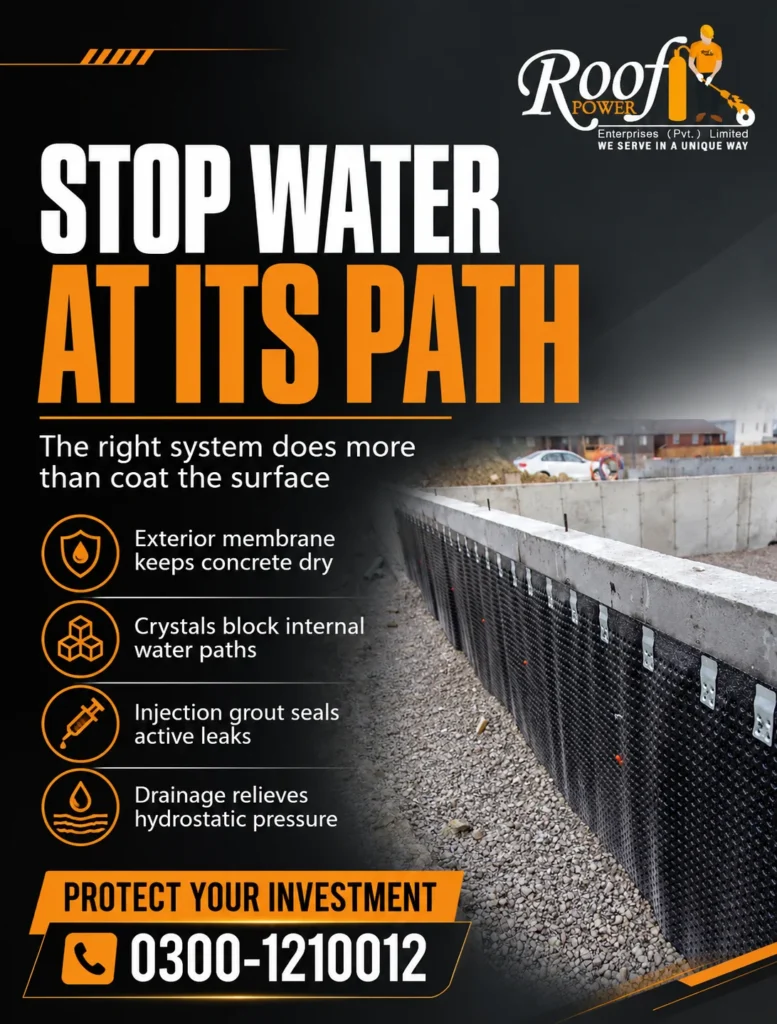
Exterior membrane systems. Where the exterior is accessible or the basement is under construction, we apply bitumen or HDPE membrane to the outside face, protect it with a drainage board or protection layer, and detail every joint — the most durable solution because the structure never gets wet.
Interior crystalline & cementitious systems. Crystalline waterproofing penetrates the concrete and forms crystals that block water paths within the slab itself — it becomes part of the concrete rather than a coating on top, which is why it resists negative-side pressure better than a simple paint. Cementitious slurries bond into the surface and are well suited to walls and floors.
Injection grouting. For active leaks at cracks and joints, PU or acrylate grout is injected under pressure to fill and seal the water path from within.
Water stoppers at joints. PVC water stoppers seal construction and expansion joints — ideally cast in at construction, and addressed during remedial work.
Relief drainage & sump systems. Often the missing piece. A sump pit and pump, or a perimeter drain, relieves the hydrostatic pressure so the waterproofing is not fighting the full water column alone. On high-water-table sites this is frequently essential, not optional.
Our Process
- Diagnosis and written method recommendation.
- Surface preparation — remove failed coatings, open and clean cracks and joints.
- Crack & joint treatment — repair mortar, injection grouting where needed, water stoppers at joints.
- Waterproofing application — exterior membrane, interior crystalline/cementitious, or both, per the diagnosis.
- Drainage installation — sump and pump or perimeter relief drainage where the pressure requires it.
- Quality control — checked during application, not just at the end.
- Testing where the design allows.
- Handover — with maintenance guidance, including sump-pump care.
Applications
Residential — living basements, storage, gyms, home theatres, basement car parking in villas. Commercial — underground car parks, plant rooms, storage, and services floors in plazas and offices. Industrial — below-grade storage, pits, and tanks. New construction — exterior tanking applied correctly before backfill, the cheapest and most reliable time to waterproof a basement.
Practical Project Examples
Representative examples of the situations we handle. Real Roof Power project case studies with photographs are being added to this page.
Residential — Basement, Lahore. Problem: A finished basement flooding every monsoon; the owner had applied an interior coating that kept peeling off the walls. Findings: The coating was being pushed off by hydrostatic pressure from a saturated backfill after rain — a classic negative-side failure. The exterior could not be excavated due to boundary walls. Recommendation: Interior crystalline system that penetrates the concrete rather than coating it, injection grouting at active joints, and a sump and pump to relieve the pressure the coating had been fighting alone. Point of the story: The interior method wasn’t wrong — it was incomplete. Without drainage, no negative-side coating stood a chance.
Commercial — Underground car park, Karachi. Problem: Water seepage through walls and construction joints into a plaza’s underground parking; a high local water table. Findings: Joints without functioning water stops; no relief drainage. Recommendation: Joint treatment with injection grouting, crystalline treatment of walls and slab, and a perimeter drainage-and-sump system sized for the water table. Point of the story: On a high-water-table site, pressure management is the project — the coating is only part of it.
New build — Villa basement, Islamabad. Brief: Waterproof a basement correctly during construction. Recommendation: Exterior membrane tanking on the outside face with a protection and drainage layer, water stoppers cast into all joints, before backfill. Point of the story: Done at construction stage, from the outside, this is the gold standard — and a fraction of the cost of fixing it later.
What Affects the Cost
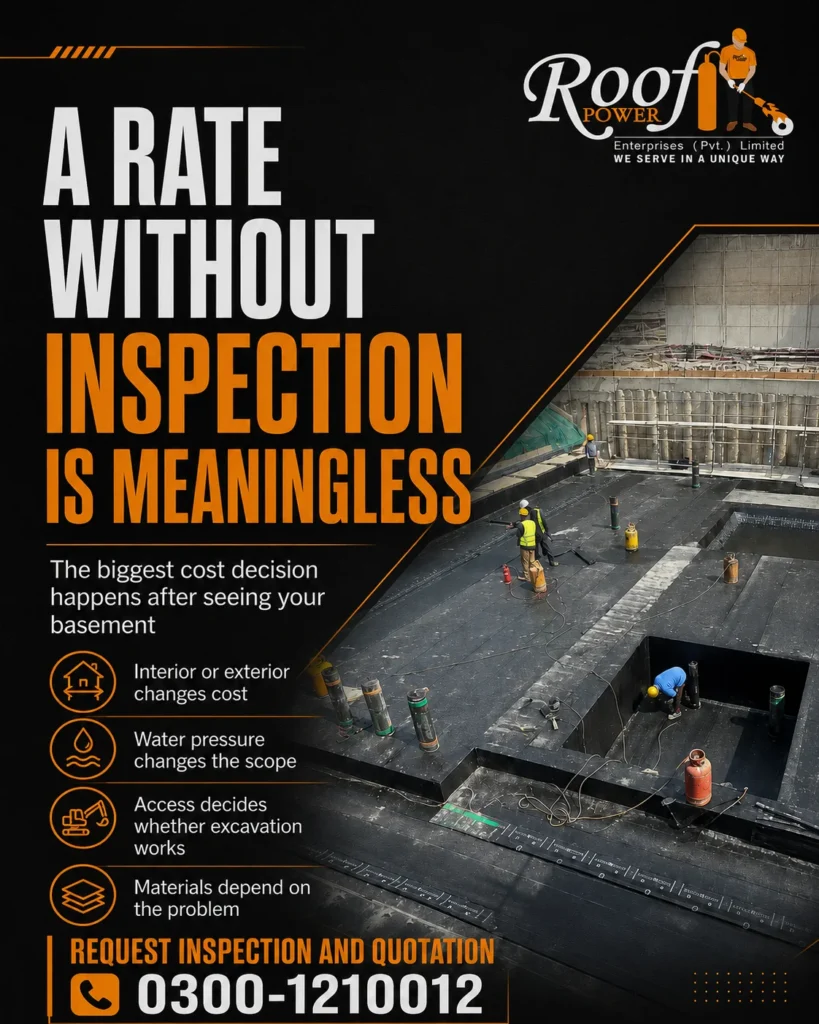
We do not publish a fixed rate, because the biggest cost variable is a decision that can only be made after inspection.
- Interior vs exterior. The single largest driver. Exterior means excavation — significant cost — but the most durable result. Interior is less disruptive and generally lower cost.
- Water pressure and drainage. Whether a sump-and-pump or perimeter drain is needed materially changes the scope.
- Extent of the problem. A localised seep versus a whole basement under pressure.
- Access. Whether the exterior can even be excavated.
- Structural repair. Crack and joint treatment required.
- Area and depth of the basement.
- Materials specified (membrane, crystalline, grout).
Pricing disclaimer: cost is provided in a written quotation after inspection. Any per-square-foot figure quoted without seeing your basement — and without deciding interior vs exterior — is meaningless.
Project Timeline
| Stage | Typical duration |
| Inspection & written recommendation | 1–2 days |
| Excavation (exterior method only) | Varies with depth and access |
| Surface prep, crack & joint treatment | 1–3 days |
| Waterproofing application | 2–5 days depending on method and area |
| Drainage / sump installation | 1–3 days |
| Curing & testing | System-dependent |
| Handover | 1 day |
Exterior projects take longer because of excavation and backfill. Interior projects are faster and less disruptive but may depend on the basement being dried out first.
Common Mistakes
Treating a basement like a roof. A surface coating on the inside, with hydrostatic pressure behind it, is the classic failure.
Ignoring drainage. Waterproofing without relieving the pressure often just moves the leak to the next weakest point.
Only ever offering interior (or only exterior). The right method depends on your basement, not the contractor’s preference.
Coating over active cracks. Structural cracks need addressing first; a coating over a moving crack simply tears.
Skipping joint water stops. Construction joints leak without them.
Waiting for the monsoon to prove there’s a problem. Damp and efflorescence are early warnings; by the time it floods, the structure has been suffering for a while.
Risks of Ignoring a Wet Basement
- Corrosion of reinforcement steel and structural weakening
- Mould and fungal growth — a genuine health hazard in an enclosed space
- Ruined finishes, stored goods, and equipment
- Musty air affecting the whole building
- A living or usable space lost entirely to damp
- Electrical safety hazards where water meets below-grade wiring
- Escalating repair cost and falling property value
Honest Limitations
Interior waterproofing has limits under high pressure. A negative-side system on a basement under severe hydrostatic pressure often needs drainage alongside it. We will tell you when interior alone is not enough, rather than sell you a coating that will be pushed off.
Exterior isn’t always possible. Where the exterior cannot be excavated, the ideal solution simply isn’t available, and we work with the best achievable interior-plus-drainage approach.
Some cracks are structural. Active, moving cracks or slab movement require a structural engineer first. Waterproofing follows structural repair; it does not replace it.
Drainage systems need maintenance. A sump pump is a machine — it needs power and periodic checking. A neglected sump is a flood waiting to happen.
Nothing is permanent. Service life depends on the method, the application, the pressure, and maintenance. Any company offering a lifetime guarantee on a below-grade structure is describing marketing, not engineering.
Why Choose Roof Power Enterprises (Pvt.) Limited
- A registered private limited company — traceable and accountable.
- 8+ years across residential and commercial below-grade work.
- We diagnose the water source and pressure before recommending a method — the step that decides whether the fix lasts.
- We offer both interior and exterior — and recommend based on your basement, not our preference.
- We understand drainage. Managing hydrostatic pressure, not just coating over it, is what makes a basement stay dry.
- Full material range — membrane, crystalline, cementitious, grouting, water stoppers, drainage systems.
- Three offices — Lahore, Islamabad, Karachi — with nationwide coverage.
- Named leadership — CEO & Founder Muhammad Haseeb Hassan reviews technical recommendations.
Frequently Asked Questions
Can a basement be waterproofed from the inside?
Yes, in many cases — using crystalline or cementitious systems that penetrate and seal the concrete, plus injection grouting at active leaks. Interior waterproofing is far less disruptive because there is no excavation. However, under severe hydrostatic pressure an interior system usually needs relief drainage (a sump or perimeter drain) alongside it, because a coating alone can be pushed off by the water pressure behind it.
What is the difference between interior and exterior basement waterproofing?
Exterior (positive-side) waterproofing is applied to the outside face of the structure and stops water before it enters the concrete — the most durable approach, but it requires excavation. Interior (negative-side) waterproofing is applied from inside and manages water after it reaches the wall — less disruptive and generally cheaper, but more limited under high pressure. The right choice depends on the water source, the pressure, and whether the exterior can be accessed.
What is hydrostatic pressure, and why does it matter?
Hydrostatic pressure is the force that saturated ground water exerts against a basement from all sides. Unlike roof water, which rests on a surface and drains, basement water is pushed continuously against the structure, so it finds every crack and pore. Managing that pressure — often with drainage — is central to keeping a basement dry.
How Much Do Basement Waterproofing Services in Pakistan Cost?
It depends heavily on whether the solution is interior or exterior, the water pressure and whether drainage is needed, the extent of the problem, access, and the materials. Exterior methods cost more because of excavation but are more durable. We provide a written quotation after inspection; a rate quoted without seeing the basement is meaningless.
Why did my basement waterproofing fail?
The most common reason is an interior coating applied against high hydrostatic pressure with no drainage to relieve it — the pressure pushes the coating off the wall. Other causes include untreated construction joints, coating over active cracks, and no diagnosis of the actual water source. It is usually a method or diagnosis failure, not a material failure.
Do you need to dig around the house to waterproof a basement?
Only for exterior (positive-side) waterproofing, which requires excavation to reach the outside face. Interior waterproofing needs no digging and is done entirely from inside — which is often the practical choice for an existing, occupied building where the exterior cannot be excavated.
Does basement waterproofing last?
A correctly diagnosed and applied system, with pressure properly managed by drainage where needed, lasts for years. Failures almost always trace back to the wrong method for the pressure, or no drainage. Sump pumps and drainage need periodic maintenance to keep performing.
What causes the white powder on my basement walls?
That is efflorescence — salt left behind as water migrates through the concrete and evaporates at the surface. It is a clear sign that water is moving through your walls, and that the basement needs proper waterproofing.
Do we need to vacate during the work?
Interior work is disruptive but usually does not require vacating the whole building. Exterior work involves excavation outside. We plan the work around your use of the space and tell you honestly what to expect.
Do you handle commercial basements and underground car parks?
Yes. Commercial below-grade waterproofing — car parks, plant rooms, storage — is a core service, including drainage design for high-water-table sites, with documentation.
Which cities do you serve?
Our offices are in Lahore, Islamabad, and Karachi, and we deliver basement waterproofing across Pakistan.
A Note from the Founder

Basements are where I see the most expensive mistakes in our whole industry — because people treat them like roofs, and a basement is nothing like a roof.
Underground, the water is not resting on your structure. It is pushing against it, from every side, and it never stops. If you coat the inside of a wall without understanding the pressure behind it and without giving that water somewhere to go, the pressure will lift your coating straight off. I have seen it a hundred times — a homeowner who paid for “waterproofing” twice because nobody managed the pressure.
So when my team inspects a basement, we start with two questions: where is the water coming from, and how hard is it pushing? The answers decide everything — interior or exterior, coating or drainage, or a combination. Sometimes the honest answer is that you need to relieve the pressure, not just seal the wall. We will tell you that.
If your basement is wet, let us diagnose it properly.
Muhammad Haseeb Hassan CEO & Founder, Roof Power Enterprises (Pvt.) Limited
Book Your Free Basement Inspection
If your basement is damp, seeping, or flooding — let us diagnose the water source and the pressure, and tell you honestly what it needs.
Call or WhatsApp: 0300-1210012 Email: roofpowers@gmail.com
Our offices: Lahore — Office No.1, Millat Tractor Cooperative Housing Society, New Defence Road Islamabad — Office No.3, Roshan Plaza, Sector H-13 Karachi — 2nd Floor, Hassan Square, Gulshan-e-Iqbal
For builders, developers, and architects: request a technical consultation. We provide below-grade waterproofing specifications, drainage design, and documentation.
Roof Power Enterprises (Pvt.) Limited — Registered Private Limited Company · 8+ Years · Waterproofing & Building Protection Across Pakistan.
Disclaimers. Recommendations are subject to physical inspection and diagnosis of the water source and pressure. Method selection depends on water table, pressure, access, and structure; some basements require combined interior, exterior, and drainage solutions. Active structural cracks or movement require engineering assessment before waterproofing. Pricing is provided in a written quotation after inspection. Warranty terms depend on the method and scope and are stated in the quotation. Excavation, confined-space, and electrical (sump) work follow site safety protocols.